Where the units we use come from. Why they have the values they do.
A quarter of a million local measures, six years of expedition across a country at war, a hidden error that haunted an astronomer to his death — and a unit that today depends on no physical object at all. This is how humanity measured the world.
All of descriptive statistics rests on a single trade: you give up information about a crowd and receive one number in return. The trade is often worth making, but it is never free — and it pays to know exactly what gets lost in it. From the mortality tables of 1662, through Quetelet's average man, to the aircraft nobody ever saw.
The whole definition of a function comes down to one word: uniqueness. One argument, one value — and not a single one more. That seemingly minor condition decides why a circle is not the graph of a function, why a line and a parabola describe so much of the world, and why four datasets with identical summary statistics can look nothing alike.
The height of a tower, the width of a river, the distance to a ship offshore — all of it can be computed without going anywhere near the thing being measured. The whole of trigonometry rests on one observation: the ratio of two sides in a right triangle depends only on the angle, not on how big the triangle is. That is what turns an angle into a number — and lets it be tabulated once and for all.
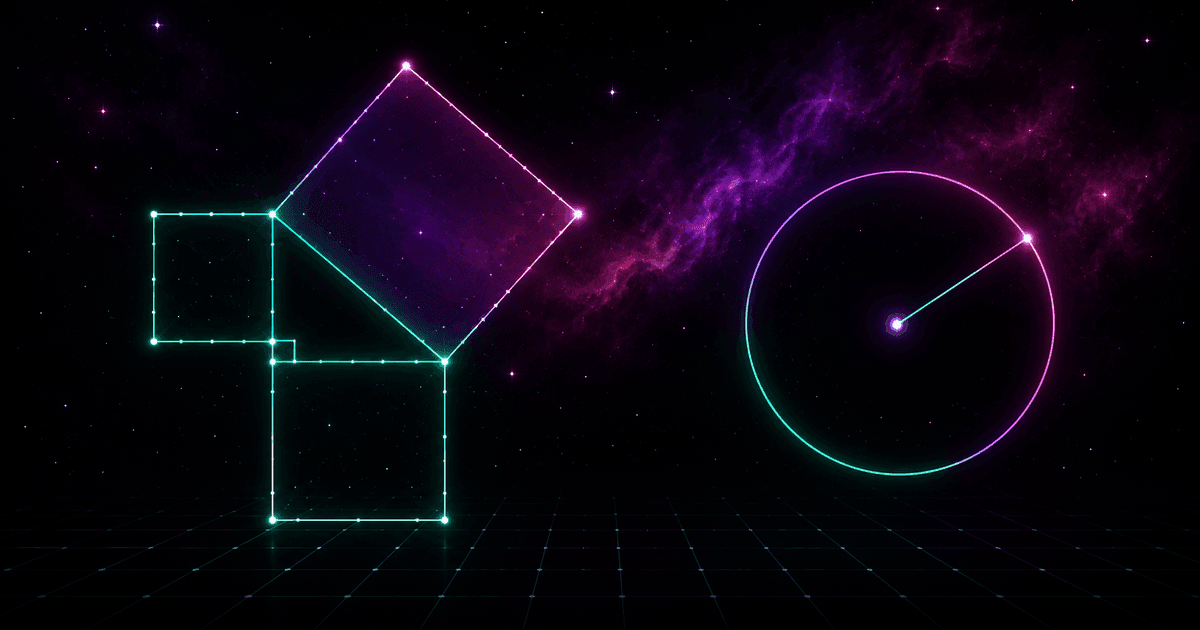
Perimeter is counted in metres, area in square metres — and that single exponent is behind most of the mistakes people make in plane geometry. It is why 1 m² is not 100 cm², why two plots with identical area can need wildly different amounts of fencing, and why the Pythagorean theorem is really a statement about the areas of squares rather than the lengths of sides.
The letter x does not always mean the same thing. Sometimes it is a number you are hunting for, sometimes a quantity that varies continuously, sometimes a blank waiting for any number at all. Here is where algebraic notation came from, why it took two thousand years to arrive, what exactly separates an unknown from a variable and a parameter, and why an inequality flips when you multiply by a negative number.
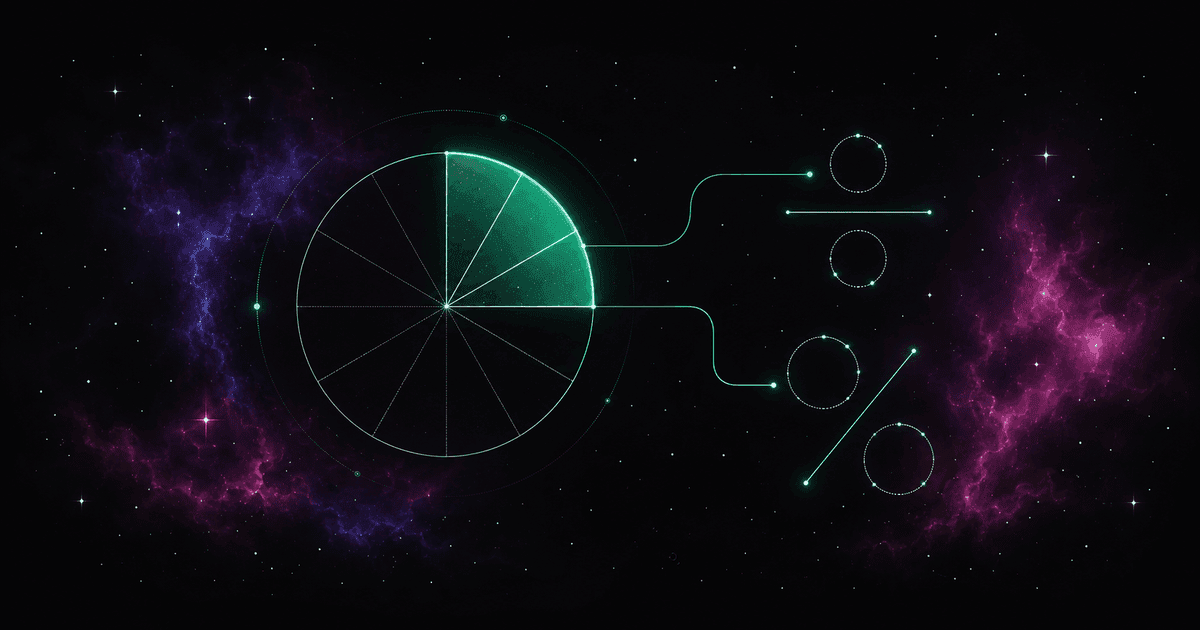
1/2, 0.5 and 50% are not three different things but three ways of writing the same number. Here is where the fraction bar, the decimal point and the % sign came from, why 1/3 never ends, why +20% and −20% do not return you to the start, and why fractions are the first serious wall in school mathematics.
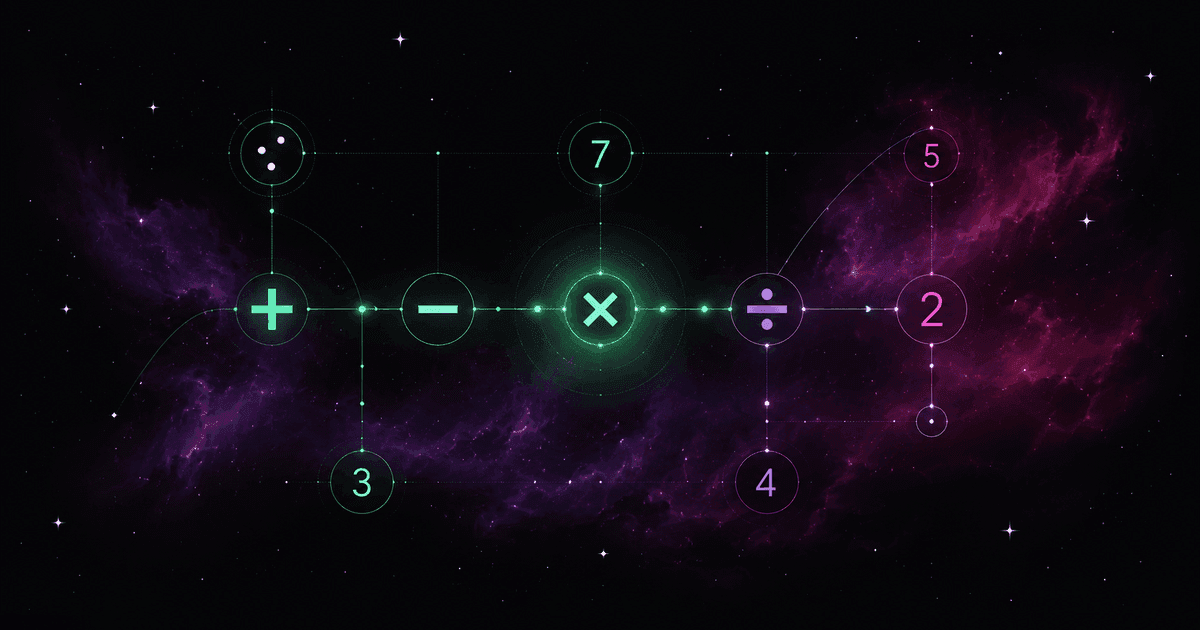
Nobody invented +, −, × and ÷ overnight, and the fight over 6 ÷ 2(1+2) still splits the internet. Here is why the notation of arithmetic is a human convention, the results are absolute truth, and division by zero simply cannot be defined.
Red is #FF0000, rgb(255, 0, 0), hsl(0, 100%, 50%) and oklch(0.628 0.258 29.2) — four strings, one color. Here is why some notations are mathematically exact while others merely pretend to understand how you see: why HSL claims yellow and blue are equally light, and why oklch finally agrees with your eye.
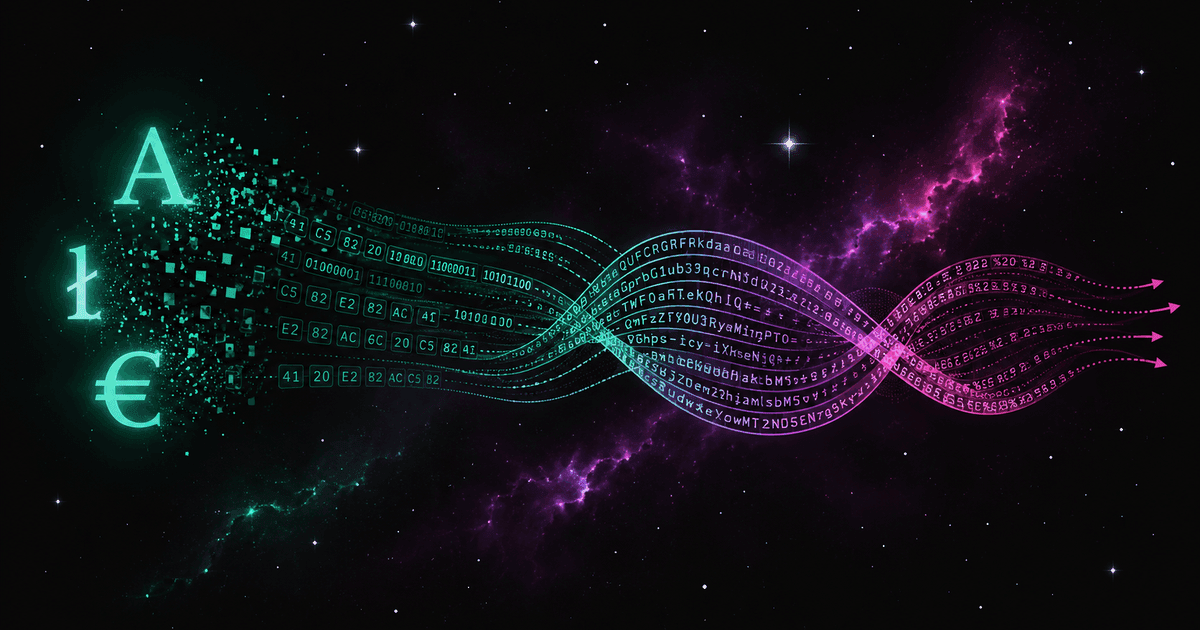
The letter "A" is the number 65, but the Polish "ł" is already two bytes, and a rocket emoji — four. Here is how a computer turns writing into zeros and ones: why the choice of encoding is a convention while the conversion itself is strictly mathematical, where "mojibake" comes from, why Base64 is not encryption, and how a single forged byte once cracked servers open.
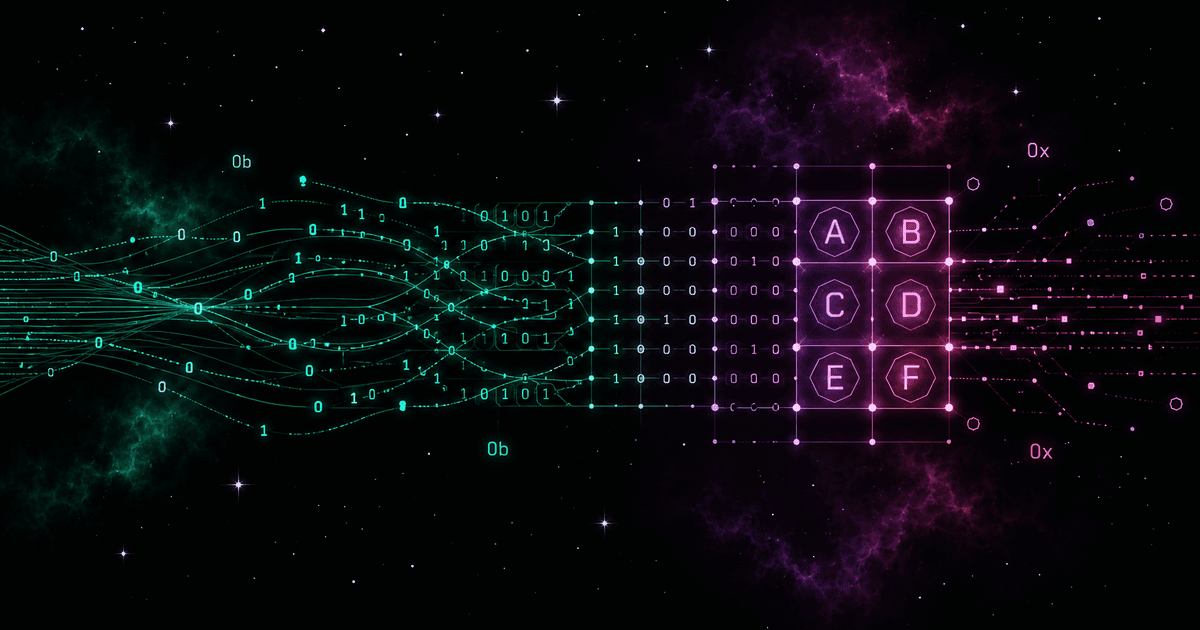
255, 0xFF, 0o377 and 0b11111111 are the same number — only the notation changes. Here is why the transistor forced machines into binary, why humans cannot read raw bits without hex, and where chmod 755, the colour #00FF00 and the oldest trap in programming — the leading zero — come from.
Hold a sensitive counter to a ripe banana and every few seconds you hear a click. Press it to your own chest and it breaks into a burst of crackles. Right now your body is firing thousands of invisible particles — with no disaster involved. Meet the becquerel: the unit that counts the pulse of the microworld, yet cannot tell you whether to be afraid.

Turn on a second identical speaker and the noise level rises by just 3 decibels — from 60 to 63, not to 120. "Zero decibels" doesn't mean silence, and the quietest room in the world sits at −24.9 dB. Here is why the ear hears the world logarithmically, and where physics' most misunderstood unit comes from.
Röntgen saw the bones of his wife's hand straight through her skin, yet no one could measure the force that did it. The first radiologists tamed the invisible with ordinary air — and so the roentgen was born, a unit with the "ugly" number 2.58×10⁻⁴ that ruled dosimetry for half a century.
A banana, a flight to New York, and a dental CT scan are all measured in the same unit — the microsievert. That is no accident. The sievert does not count the energy of radiation, but its real harm to living cells. Here is how one physicist turned subatomic collisions into a single, readable language of risk.
Two children on one carousel, the exact same revolutions per minute — yet one barely moves while the other clings to the railing. The culprit is a single short equation that rules everything that spins: from a vinyl record to a supersonic ultracentrifuge.
Turn a jar of honey and a bottle of water upside down at the same moment — the same gravity pulls on both, yet one escapes in a heartbeat while the other lazily spins a thick thread. That is not density but dynamic viscosity: the invisible brake that rules ketchup, engine oil, and the longest-running experiment in the history of science.
You're racing along at nearly a thousand kilometers per hour, ten kilometers up, and calmly pouring a coffee. A one-second climb to the top of a roller coaster pins you to your seat. Why? Because the body has no sense of speed — it reacts only to acceleration. Here is the physics of that difference, from an 1901 decree to Colonel Stapp's 46 g.
A dose of 60 grays aimed at a tumor saves a life. A dose many times smaller, spread across the whole body, kills with no hope of rescue. Same unit — and less energy than a crumb of chocolate carries. This is the thermodynamic paradox of the absorbed dose.
A light-bulb box shouts “800 lumens,” “1600 lumens” — and it feels obvious that a bigger number means a brighter room. It is a trap. Whether you see well is decided by the lux: how much of that emitted light actually lands on your desk. This is the story of illuminance — the inverse-square law, why a full moon gives a quarter of a lux yet still lets you walk at night, and why the office standard is exactly 500 lux.
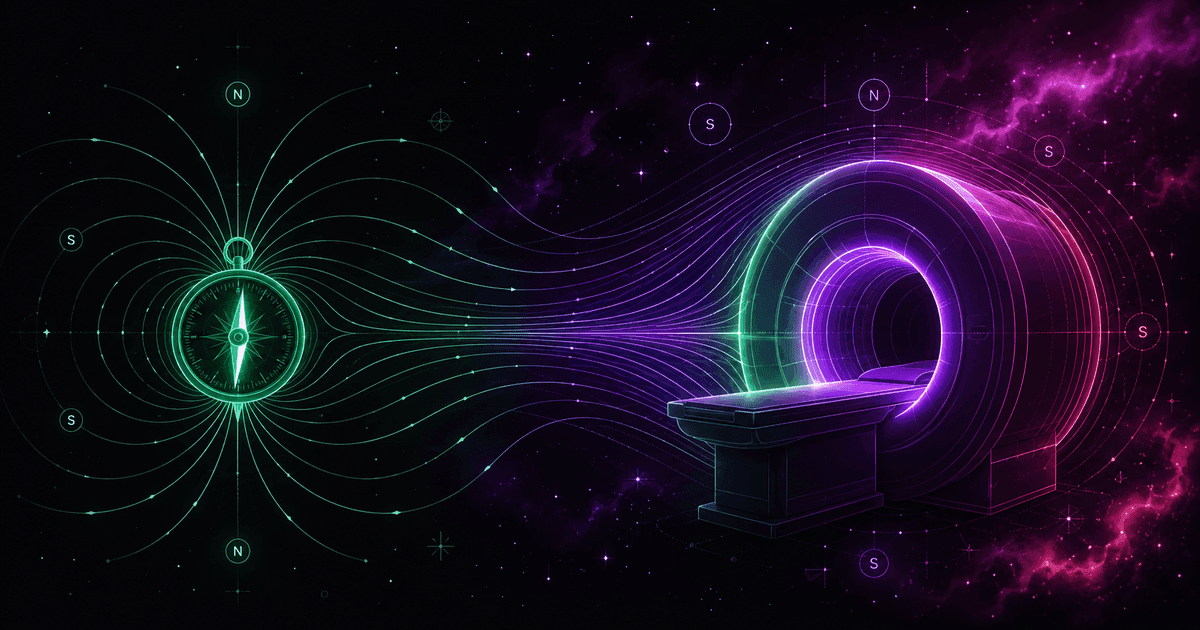
A compass needle points north flawlessly, guiding sailors for centuries — yet the field that steers it is hundreds of times weaker than a cheap magnetic toy on a fridge door. This is a journey across the scale of magnetic flux density: from the quiver of a compass, through the mighty teslas of an MRI scanner, to cosmic magnetars.
Screen makers outbid each other on “nits,” yet almost no one explains what the number means — or why a “2000-nit” TV rarely puts out 2000 nits across the whole panel. This is the story of luminance: a unit with a Latin pedigree, why the number π hides inside light measurements, and what to actually look at when buying a bright screen.
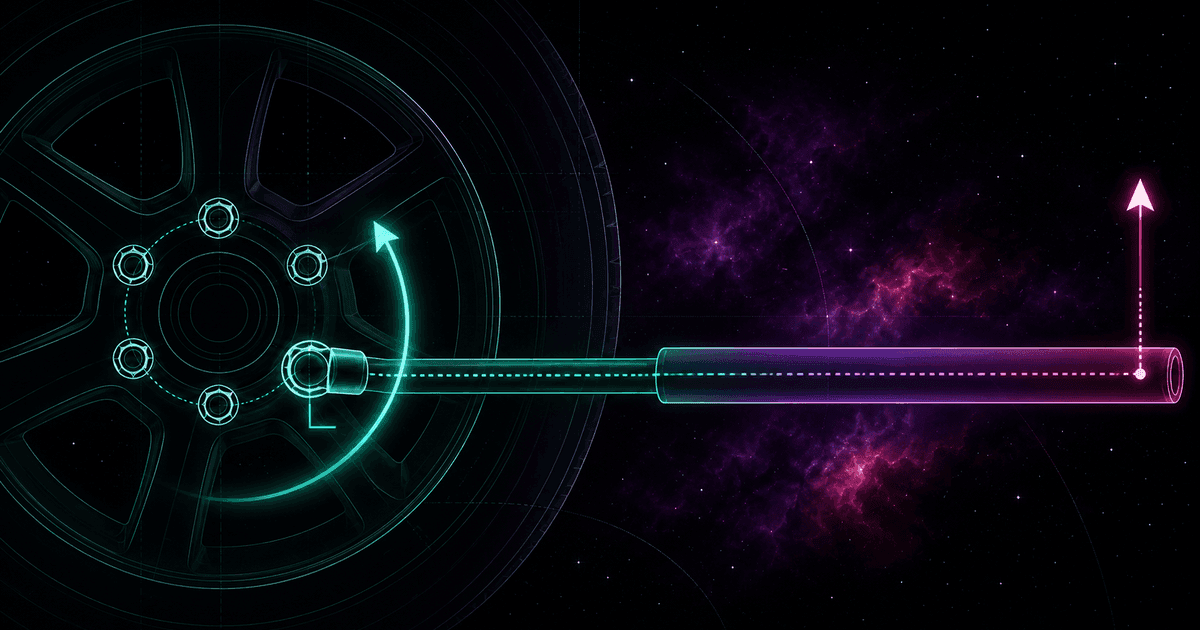
A one-meter pipe slipped over a wrench frees a bolt you cannot budge bare-handed. The newton-meter and the joule share an identical dimension, yet physicists strictly forbid confusing them. And an electric motor pulls at full strength from zero rpm. Here is what really hides behind the "400 N·m" on a spec sheet.
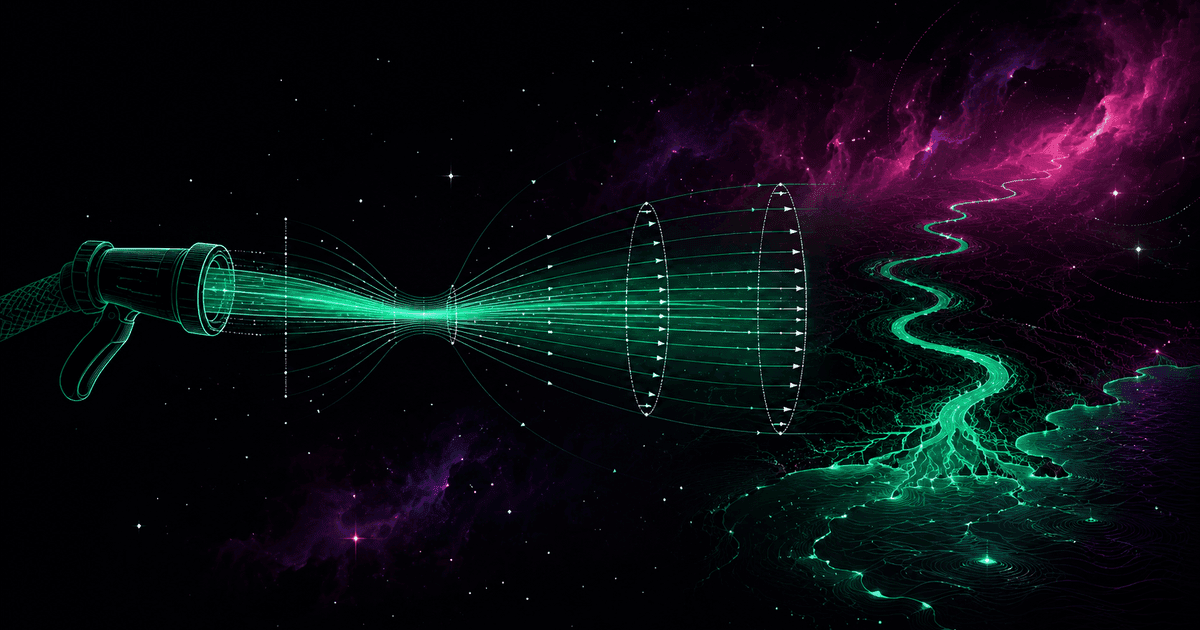
Press a thumb over the end of a garden hose and the stream leaps across the yard — even though no more water is actually flowing. A tap left running while you brush your teeth moves more water than your heart pumps through your whole body. And the Amazon shoves over 80 Olympic pools into the ocean every second. One law of physics ties the bathroom, the human heart and the largest river on Earth.
The designer thinks in pixels, the typesetter in points, and the client holds a millimeter ruler up to the print — and nothing matches. This apparent Tower of Babel is not a lack of standards but five centuries of evolution: from lead type and "magpie" books, through the Apple–Microsoft war over screen resolution, to the CSS pixel that is not a dot on the panel at all.
Your watch reads "5:30" and you instinctively look for kilometers per hour. In running the distance is fixed in advance, so what matters is the time per kilometer — which is why a smaller number means a faster run. Here is the math of pace: the rule of 60, the decimal trap, the nonlinear hyperbola, and why your GPS pace goes haywire.
You pay for 100 megabits and your browser shows 12 megabytes — and nothing is wrong. Here is where that factor of eight comes from, how baud differs from bits per second, and why a gigabit line will never quite give you 125 MB/s.
The schoolyard riddle has three floors. On the first, both kilograms weigh the same. On the second, a pound of feathers turns out to be heavier than a pound of gold. On the third, a scale in an ordinary room shows sixty grams between them — and the air is to blame. A story about density: the quantity that divorced the litre from the cubic decimetre for 63 years, floats ice on water, and demolishes the legend of Archimedes' bathtub.
Your pocket phone holds a thousand times more electrons than a bolt of lightning, and yet a 20,000 mAh power bank will not fill a 5,000 mAh battery four times over. Nobody is cheating you. The culprit is the difference between charge and energy — and one number manufacturers dislike printing in large type.
The weather report gives pressure in hectopascals, the gauge on your pump has two scales — bar and PSI — and your car manual talks in bar. It is all one phenomenon wearing different uniforms. Here is how to read pressure without slipping up: why tires soften on their own in the cold, why a "3" on the dial can mean two wildly different things, and how much air really belongs in your wheel.
A single unit — "once per second" — ties together nearly all of modern technology. The same hertz describes the note you hear, the power in your outlet, the reach of a radio signal, how smooth your phone screen feels, and your processor's clock. Here is how a count of repetitions per second became the common denominator of the digital world.
You buy a "1 TB" drive, plug it in, and Windows reports 931 GB. Nothing was lost and nobody cheated you — it is a collision of two number systems, a hidden flash reserve, and a "formatting tax". We break the missing gigabytes down to the last byte.
The whole world counts in tens — except on the clock. An hour splits into 60 minutes, a minute into 60 seconds, a circle into 360 degrees, because four thousand years ago the Sumerians counted on the joints of their fingers. Here is why the Babylonian order outlived revolutions, empires, and the digital age.
The entire physical world was decimalized — except the angle. A full turn is still 360 degrees, not a round 100 or 1000. That is no accident and no superstition: behind 360 lie exceptional divisibility, thousands of years of astronomy, the definition of the nautical mile, and a theorem named after pizza.
A calorie on your plate, a joule in the lab and a kilowatt-hour on your electricity bill all describe exactly the same thing: the ability to do work. One traditional doughnut holds about 407 watt-hours of energy — enough to run an efficient LED for more than a day, or charge a smartphone nearly 24 times. Here is how a single pastry ties together nutrition, physics and your power bill.
We live in the age of electric cars and processors, yet we still rate engine power in a unit based on a working horse from an 18th-century mine. Horsepower is one of the most durable marketing coups in the history of engineering — invented to sell steam engines. Here is where it came from, why 1 hp is not the power of one horse, and why the authorities insist on kilowatts.
The same ell was three different lengths in Gdańsk, Kraków and Vilnius, and an inch was laid out from twelve barley grains. This is the story of Poland’s old units of length — iron rods set into town-hall walls, failed attempts at unification, and the road that finally ended in the metre.
Kibibyte, mebibyte, gibibyte — those odd words with an "i" in the middle look like a typo, yet they are the only honest units of memory. A story of how "kilo" came to mean 1024, why a 1.44 MB floppy is neither binary nor decimal, and why your internet is measured on a completely different scale than your drive.
Han Solo bragged he made the Kessel Run in less than twelve parsecs — but a parsec is a unit of distance, not time. We make the same slip with the light-year. Here is how astronomy handles distances that will not fit on Earth — and why our brains stumble over them.
Headlines talk about "a ton of impact force," and seatbelt makers about "hundreds of kilograms of pressure." To a physicist, that confuses mass with force. Here is what a newton really means, why a stiletto heel is more dangerous than an elephant, and where the force that can shatter a phone — or save your life in a crash — actually comes from.
A wooden chip towed astern, an eddy-current cup on the dashboard, and the thermodynamics of a sound wave at cruising altitude. Land, sea, and air each grew their own unit of speed — and every one follows directly from the physics of its element.
Three gallons in one kingdom, wine against grain, a government that raised fuel duty without touching the rate, and British cars that "burn less" than identical American ones. Two gallons differ by a fifth — enough to ruin every fuel-price comparison, every recipe, and every economy figure.
Three different pounds in one kingdom, a Warsaw pound and a Prussian one, a probe burned up over Mars, a jetliner out of fuel over Canada — and a platinum cylinder near Paris that kept losing weight for a century, even though by definition it weighed exactly one kilogram. This is the history of mass units and its expensive mistakes.
Fahrenheit's zero was a slurry of ice, water and sal ammoniac, reproducible in an Amsterdam workshop. Celsius's zero meant boiling water for three years. Kelvin's zero is a limit the universe never crosses. Three scales, and three entirely different answers to the question of where counting heat should begin.
An acre is as much as eight oxen can plough between dawn and dusk. A morgen is the work of a morning, before the heat forces the team to stop. A hectare is a square one hundred metres on a side, and nothing more. Three ways of measuring land — and one reason a morgen can still cost you several thousand zloty.