
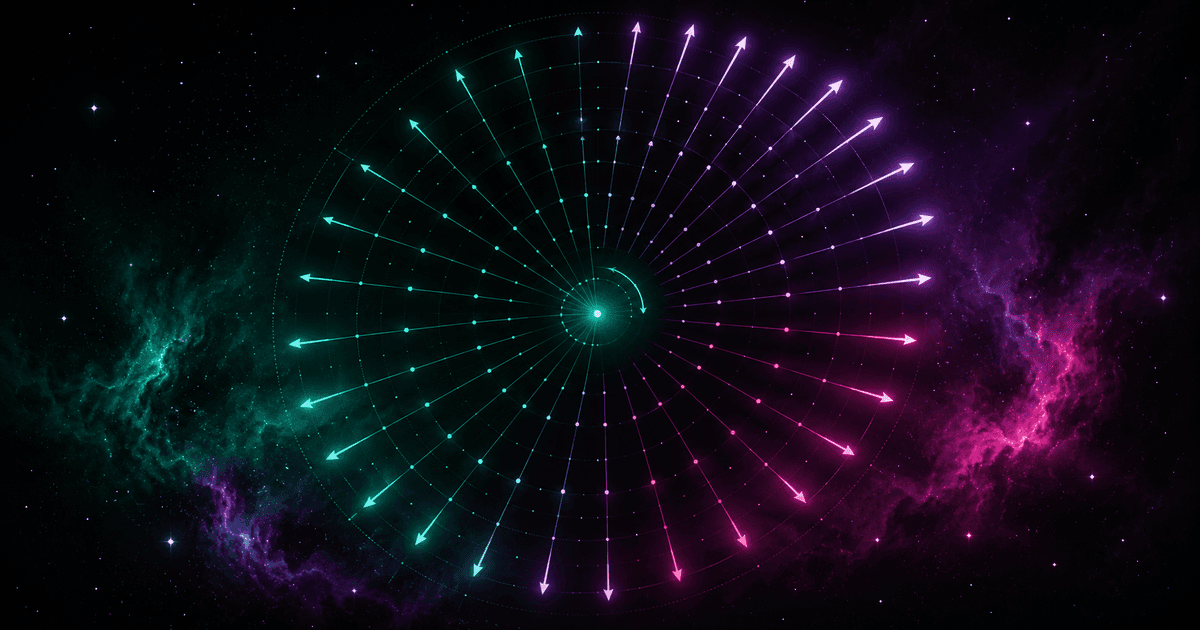
A playground evokes carefree fun, but for a physicist it is a laboratory of classical mechanics. Picture a classic rotating carousel and two children: one sits right by the axis, almost at the geometric center, the other stands at the very edge. The platform starts to turn. Soon it turns out that although both begin and end each full loop in the same fraction of a second, their experiences are worlds apart. The child in the center sways gently and feels almost no effort. Its peer at the edge clings to the railing, fighting the rush of air and centrifugal force.
How is that possible, if both spin on the same platform and make exactly the same revolutions per minute? The key lies in distinguishing two ideas that everyday speech merges into one: angular velocity and linear velocity. This distinction explains not only the carousel, but also why a vinyl record distorts sound near the label, and why a dental drill has to spin hundreds of thousands of times a minute.
What angular velocity really is
In everyday life, velocity means covering distance: a car drives so many kilometers per hour. That is linear velocity — the change of a point's position in space. But for an object spinning around a fixed axis — a clock hand, a rotor, a planet — measuring distance in meters becomes useless, because every point of such a body covers a different distance in the same time, depending on how far it is from the axis.
That is why physics introduces angular velocity, denoted by the Greek letter ω (omega). Instead of measuring distance in meters, it measures the angle a body turns through per unit of time — the ratio of the angle increment Δθ to the time Δt:
ω = Δθ / Δt
For uniform circular motion this value is constant: in equal intervals the radius sweeps out equal angles. The SI unit is the radian per second (rad/s) — not the degree, even though degrees are what we know from everyday life.
Why the radian and not the familiar degree? Because the radian follows straight from the geometry of a circle and is dimensionless. It is defined as the central angle for which the arc length s equals the circle's radius r — that is, θ = s / r. Since we divide a length by a length (meters by meters), the units cancel and the result is a pure number. That lets the radian enter the equations of physics without any of the artificial conversion factors that dividing a circle into an arbitrary 360 parts would drag along.
The conversions you cannot avoid
The catch is that the world of engineering barely uses radians per second. On a car's tachometer, in a drive or engine datasheet, the revolution per minute (rpm) reigns. To move freely between the world of physics and the world of engineering, you need a few bridges. All of them grow from a single identity — a full turn is an angle of 360°, or exactly 2π radians (the circumference 2πr divided by the radius r):
1 rev = 2π rad = 360°
Hence:
- rev/s → rad/s: one revolution per second is 2π rad/s ≈ 6.2832 rad/s.
- rpm → rad/s: a minute has 60 seconds, so divide 2π by 60 — the factor is π/30 ≈ 0.10472. To turn a tachometer reading into rad/s, multiply the revolutions by 0.10472.
- °/s → rad/s: since 360° is 2π rad, one degree is π/180 ≈ 0.017453 rad.
These are not rough approximations — exactly the same factors (π/180, π/30, 2π) power the angular velocity converter on this site.
The "aha" moment: v = ω · r
The carousel puzzle is solved by one compact equation linking a point's linear velocity v, its angular velocity ω, and its distance from the axis r:
v = ω · r
It follows easily: the arc-length distance is s = r · θ, and since the radius of a rigid body is constant, the time derivative gives v = r · ω. The conclusion is crucial: at a constant angular velocity, linear velocity grows in proportion to the distance from the axis. Every point of a rigid body has the same ω — it completes a full turn in the same time. But points farther out have a larger circumference to cover, so they must race through space faster.
Let's compute a carousel that makes one turn in 10 seconds. Its angular velocity is:
ω = 2π / 10 s ≈ 0.628 rad/s
The child in the center, at r = 1 m from the axis, moves at v = 0.628 · 1 ≈ 0.63 m/s (about 2.3 km/h) — a walking pace. The child at the edge, at r = 5 m, has v = 0.628 · 5 ≈ 3.14 m/s (about 11.3 km/h) — the pace of a fast run. Same platform, same rpm, yet the linear velocity differs fivefold. The whole secret sits in the radius.
Vinyl: physics written into the groove
The same mechanism governs a classic vinyl LP (12 inches, 30.48 cm), which spins at a constant 33⅓ rpm, that is:
ω = 33.33 · 0.10472 ≈ 3.49 rad/s
When the needle is at the start of the record, on the outer edge with a radius of about 15 cm, the groove moves past it at v = 3.49 · 0.15 ≈ 0.52 m/s. Near the end of the album, right by the label, the radius drops to about 5 cm and the linear velocity is now only v = 3.49 · 0.05 ≈ 0.17 m/s — exactly three times less.
This has real consequences. Near the center, one second of music gets three times less physical groove length, so recording high tones, which need densely packed waves, becomes harder there. Hence inner groove distortion, which engineers fought for decades — with special stylus profiles (elliptical, Shibata) and precise tonearm geometry.
Angular velocity vs. frequency — not the same thing
In technical writing, angular velocity and frequency are often confused, because in dimensional analysis both reduce to the inverse second (s⁻¹). Physically, though, they are different. Frequency f (hertz, Hz) simply counts complete cycles per second — it says "how many times." Angular velocity ω measures the rate of continuous angle change — it says "how fast the vector turns" at each instant. They are linked by:
ω = 2π · f
The factor 2π comes from the fact that one full cycle is a turn of 2π radians. In vibration theory ω is also called angular frequency. And although the radian is formally dimensionless, in practice we always write "rad/s" explicitly to tell ω apart from hertz — a mistake by a factor of 2π ≈ 6.28 in a drive, filter, or AC generator design would be catastrophic.
The scale of rotation: from a lazy Earth to a dental drill
Rotational motion spans an unimaginable range of scales. Earth spins around its axis once per sidereal day (86,164 s), giving a microscopic ω ≈ 7.29 × 10⁻⁵ rad/s (just 15° per hour). And yet, with an equatorial radius of 6,378 km, the linear velocity of a point on the equator reaches v ≈ 465 m/s (1,674 km/h) — faster than sound. Spaceflight exploits this free "bonus": rockets launched near the equator (as from Kourou in French Guiana) get a velocity boost at liftoff and save fuel.
At the other extreme is the dental turbine. Driven by compressed air, it reaches up to 300,000–450,000 rpm with no load. Why so much? Again because of v = ω · r: the bur itself has a radius of barely 0.8 mm, so to get a sensible cutting speed at its edge, ω has to be enormous. At 380,000 rpm (≈ 39,800 rad/s) the linear velocity at the rim of the bur is v ≈ 31.8 m/s (114 km/h) — enough to cut hard enamel smoothly and without vibration, with little pressure and no cracking of the tooth from stress.
The table below orders objects by increasing angular velocity and shows how it is the radius that decides the linear velocity of the edge.
| Object | Typical rotation | ω (rad/s) | ω (°/s) | Radius r (m) | v at the edge (m/s) |
|---|---|---|---|---|---|
| Earth's rotation | 1 rev / sidereal day | 7.29 × 10⁻⁵ | 0.00418 | 6,378,000 (equator) | 465.1 |
| Second hand | 1 rpm | 0.105 | 6.0 | 0.10 | 0.010 |
| Vinyl record (LP) | 33⅓ rpm | 3.49 | 200 | 0.152 (edge) | 0.53 |
| Single | 45 rpm | 4.71 | 270 | 0.089 (edge) | 0.42 |
| Helicopter rotor (R22) | 530 rpm | 55.5 | 3,180 | 3.84 (blade tip) | 213 |
| Engine idle | 800 rpm | 83.8 | 4,800 | 0.05 (crank journal) | 4.2 |
| HDD (laptop) | 5,400 rpm | 565 | 32,400 | 0.0475 (3.5" platter) | 27 |
| Engine redline | 6,500 rpm | 681 | 39,000 | 0.05 (crank journal) | 34 |
| HDD (performance) | 7,200 rpm | 754 | 43,200 | 0.0475 (3.5" platter) | 36 |
| Lab centrifuge | 15,000 rpm | 1,571 | 90,000 | 0.08 (rotor) | 126 |
| Ultracentrifuge | 100,000 rpm | 10,472 | 600,000 | 0.08 (rotor) | 838 |
| Dental drill | 380,000 rpm | 39,800 | 2,280,000 | 0.0008 (bur head) | 32 |
Two myths worth defusing
"If the whole record spins at the same rpm, everything on it moves at the same speed." No. Angular velocity is shared across the whole disc, but linear velocity depends on the radius. The vinyl particles at the edge race three times faster than those near the center — even though the record turns as a single rigid body.
"rpm and hertz are the same thing." Not quite. True, 1 Hz = 60 rpm, and both units describe repetition. But radians per second bring the geometry of the circle into the picture through the factor 2π. Hertz tells you "how many times" something repeats; rad/s tells you "how fast" the vector turns at each instant — and only that lets you compute centrifugal forces and the system's dynamics.
Engineering the extreme: a supersonic vacuum
The finest showcase of the power of angular velocity is the ultracentrifuge, whose development was pioneered by the Swedish chemist Theodor Svedberg in the 1920s (Nobel Prize, 1926). He noticed that separating tiny particles such as proteins requires gigantic centripetal accelerations. Early designs overheated; the breakthrough came in 1935, when Edward Pickels introduced a vacuum chamber.
When the rotor spins at 100,000 rpm (ω ≈ 10,472 rad/s), its edge at a radius of 8 cm reaches a linear velocity of 838 m/s (about 3,016 km/h) — more than twice the speed of sound. In air, friction of gas molecules against the metal would heat the device to several hundred degrees, cook the sample, and destroy the rotor. Pumping the air down to a high vacuum removes the friction and allows stable operation. The centrifugal force is so large that tubes must be balanced to thousandths of a gram — the slightest mass asymmetry could tear the rotor apart.
The takeaway: rpm says "how fast it spins," the radius says "what follows"
A tachometer reading, a drive's spec sheet, a record's label all give the rotational speed (rpm) — a universal measure of the pace of rotation, the same for every point of the body. But the real effects of that motion — linear velocity, the rush of air, inertial force, and destructive centrifugal force — depend on geometry. It is the radius that decides whether the edge rolls lazily near the axis or races supersonically on the outside. Grasping this single relationship is what lets engineers design safe helicopters, efficient surgical tools, and precise centrifuges that push the limits of science.
Further reading
- David Halliday, Robert Resnick, Jearl Walker, Fundamentals of Physics, Vol. 1 (2015) — the classic textbook; its chapter on rigid-body rotation ties angular quantities precisely to linear ones.
- Richard P. Feynman, Robert B. Leighton, Matthew Sands, The Feynman Lectures on Physics, Vol. 1 — an intuitive treatment of rotational dynamics and inertial forces.
- OpenStax, University Physics, Vol. 1, ch. 10 "Fixed-Axis Rotation" — a free, rigorous introduction to ω, α, and the relation v = ω·r.
- BIPM, The International System of Units (SI Brochure), 9th ed. (2019) — the status of the radian as the unit of angle and its place in the SI.