
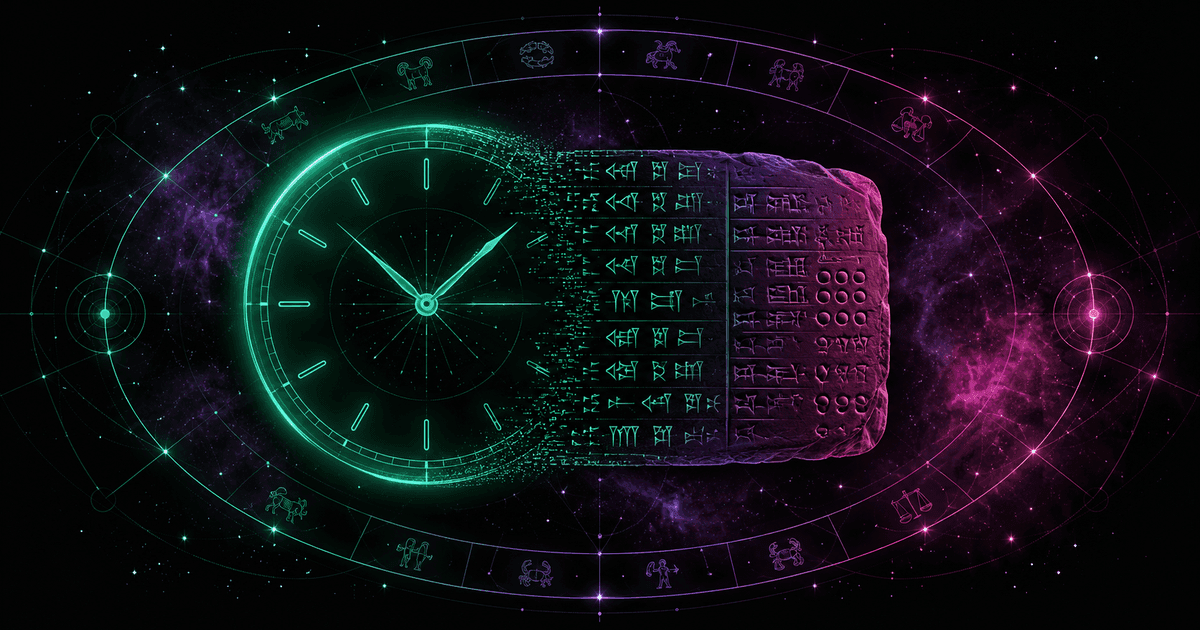
We count almost everything in tens. We have ten fingers, so base 10 feels obvious — until we look at a watch. There an hour splits into 60 minutes, a minute into 60 seconds, and a full sweep of the hand traces 360 degrees. This breach in the decimal hegemony is neither an accident nor a whim. It is humanity's oldest still-working invention — a legacy of the Sumerians and Babylonians that has survived four thousand years, revolutions, and the birth of the digital age.
Sixty is born in clay
The sexagesimal (base-60) system was born among the Sumerians in the 3rd millennium BCE, and was later inherited and refined by the Babylonians. Despite the name, it was not a "pure" system of sixty symbols — it worked as a hybrid, with ten serving as an auxiliary sub-base.
Sumerians and Babylonians wrote numbers in cuneiform on clay tablets, using just two marks: a vertical wedge for units and a wide, slanted wedge for tens. The digits from 1 to 59 were built additively from these, and above 59 they used a sophisticated positional notation based on powers of sixty. There was only one problem: for a long time there was no symbol for zero. The same combination of wedges could mean 1, 60, or 3600 (60²), and the correct value had to be read from context or from the gaps between digits. Only later did a separator sign appear, acting as a "medial zero" — but it never developed into a trailing zero.
Sixty ran through the entire Mesopotamian economy. By the end of the 3rd millennium BCE, units of weight rested on the same structure: a talent (about 30 kg) divided into 60 minas (about 0.5 kg), and each mina into 60 shekels. When the Greeks adopted these measures, they simplified the division to 50 shekels per mina — which nicely shows how deep and how uniquely Mesopotamian the original base 60 was.
Why 60, exactly? The hand and the arithmetic
Where did this particular choice come from? Part of the answer lies in the anatomy of the hand. The most frequently cited theory — popularized by the French mathematician Georges Ifrah — describes a technique of counting on finger joints, still used today in parts of Asia and the Middle East.
With the thumb of one hand you touch the successive phalanges (segments) of the other four fingers. Each of those four fingers has three phalanges, giving 12 on one hand (4 × 3). When you reach twelve, you mark it off with one finger of the other hand. The five fingers of the helper hand let you count five full "dozens" — exactly 60 (12 × 5). This simple method combined the advantages of the duodecimal and decimal systems, and let merchants handle large numbers without a tablet and stylus.
But sixty also had hard arithmetic in its favor. 60 is the smallest number divisible without remainder by every integer from 1 to 6. It has twelve divisors (1, 2, 3, 4, 5, 6, 10, 12, 15, 20, 30, 60), whereas ten has only four (1, 2, 5, 10). In an age without decimal fractions, divisibility decided everything: a whole could be split into halves, thirds, quarters, fifths, or sixths and always yield a whole number.
The table below shows why that was so convenient — the same simple fractions in three systems:
| Fraction | Base 10 (decimal) | Base 12 (duodecimal) | Base 60 (sexagesimal) |
|---|---|---|---|
| 1/2 | 0.5 | 0.6 | 0;30 |
| 1/3 | 0.333… (recurring) | 0.4 | 0;20 |
| 1/4 | 0.25 | 0.3 | 0;15 |
| 1/5 | 0.2 | 0.2497… (recurring) | 0;12 |
| 1/6 | 0.1666… (recurring) | 0.2 | 0;10 |
| 1/8 | 0.125 | 0.16 | 0;07,30 |
| 1/12 | 0.08333… (recurring) | 0.1 | 0;05 |
The notation 0;30 is the Babylonian way of writing a fraction: 30/60, i.e. one half. Notice the decimal column — 1/3 and 1/6 unfold into infinite recurring fractions that made precise accounting of goods and land hard. In base 60 they are ordinary, finite numbers. A fraction had a finite sexagesimal expansion only when its denominator held only the factors 2, 3, and 5; for others (say 7 or 13), Babylonian scribes reached for astonishingly good approximations — 1/13 was written as 7/91 ≈ 7/90, giving the neat 0;04,40.
From 360 days to 360 degrees
The Babylonians were brilliant observers of the sky, for whom astronomy was inseparable from religion. Alongside their cultic calendar, based on lunar months of 29–30 days, they used a simplified administrative calendar: 12 months of exactly 30 days each, giving an ideal year of 360 days.
That round number became the basis for dividing the heavens. The Babylonians cut the ecliptic — the Sun's apparent path — into 12 signs of the zodiac, each spanning exactly 30 degrees. And so the 360 days of the ideal year turned into the 360 degrees of the circle we still use today. We follow that thread in a separate piece: why a full circle has 360 degrees. The units of time themselves are handled by the time converter.
The split of the day into 24 hours, however, is Egypt's doing. The Egyptians divided the day into 12 hours and the night into 12. At night they measured time by the motion of 36 stars called decans, each rising every 10 days; on the shortest summer night, exactly 12 decans climbed above the horizon — and hence the division of the night into twelve parts. These were seasonal hours: summer daytime hours were much longer than winter ones. To measure them, Egyptians used sundials and clepsydras (water clocks) — the most famous surviving Egyptian clepsydra dates from the reign of Amenhotep III (14th century BCE) and was found in the temple at Karnak.
How a degree became a minute and a second
Greek astronomers fused both legacies — Babylonian mathematics and Egyptian–Greek astronomy. In the 2nd century CE, Claudius Ptolemy, in his great work the Almagest, divided each of the 360 degrees of the circle into 60 parts he called partes minutae primae ("first small parts"), and those in turn into another 60, the partes minutae secundae ("second small parts"). From these Latin names grew our words "minute" and "second."
For the whole of the Middle Ages, though, dividing the hour into minutes and seconds remained a pure abstraction of astronomers. Around the year 1000, the scholar Al-Biruni was the first to carry the sexagesimal notation directly onto units of time, splitting the hour into minutes, seconds, thirds, and fourths. But it meant nothing to ordinary people, because the mechanical clocks of the day — regulated by a primitive verge-and-foliot — ran fast or slow by 15–30 minutes a day. Marking "seconds" on such a mechanism would have been meaningless.
The breakthrough came only in 1656, when Christiaan Huygens, inspired by Galileo's discoveries, built the first pendulum clock. Huygens showed that the period of a swing is constant only for small displacements, and forced the pendulum to move along a cycloidal path to guarantee full isochronism. The next step was the anchor escapement (around 1670), which shrank the swing to just a few degrees and made it possible to use long seconds pendulums (about 99.4 cm) in slender longcase clocks. Accuracy fell to a dozen or so seconds a day — and only then, at the end of the 17th century, did minute hands appear on dials, soon followed by second hands. The Babylonian geometric order thus became the physical, universal measure of human time.
The great decimal rebellion: revolutionary France
The French Revolution wanted to rebuild the world from scratch — on a foundation of reason and the number ten. If length and weight were being reformed, why not time? A decree of 1793 introduced decimal time: the day was split into 10 hours, each into 100 minutes, each minute into 100 seconds. A revolutionary day thus held exactly 100,000 seconds — instead of the traditional 86,400.
| Traditional unit | In decimal time | Decimal unit | In traditional time |
|---|---|---|---|
| 1 second | 1.1574 decimal s | 1 decimal second | 0.864 s |
| 1 minute | 0.6944 decimal min | 1 decimal minute | 1 min 26.4 s |
| 1 hour | 0.4166 decimal h | 1 decimal hour | 2 h 24 min |
| 24 hours (day) | 10 decimal hours | 10 decimal hours | 24 h (full day) |
It came bundled with the revolutionary calendar: 12 months of 30 days, split into three ten-day décades instead of weeks, with poetic month names (Vendémiaire, Brumaire, Nivôse) coined by the poet Fabre d'Églantine. Pierre-Simon Laplace himself ordered a decimal pocket watch and wrote the first two volumes of his Celestial Mechanics (1799) entirely in the new units.
The experiment collapsed almost at once. Official decimal time ceased to be mandatory on 7 April 1795, after just seventeen months. The ten-day week drastically cut workers' rest, the abolition of Sundays offended the Catholic countryside, and the new clocks were simply too expensive. On 1 January 1806 Napoleon — needing peace with the Vatican — restored the Gregorian calendar. Laplace, once an enthusiast of the reform, delivered a Senate speech on its "scientific flaws," tactfully passing over his own involvement.
Poincaré and the second defeat
The idea returned at the end of the 19th century. In 1897 the French Bureau des Longitudes appointed a commission on the decimalization of time, with one of the era's greatest mathematicians — Henri Poincaré — as its secretary. Among the options was dividing the circle into 400 grades, which meshed perfectly with the metric system: the quarter meridian was defined as 10,000,000 meters, so in the 400-grade layout one grade of latitude corresponded exactly to 100 kilometers.
Despite that elegant symmetry, the project failed in 1900. Naval officers objected — changing the units would mean scrapping every nautical chart, almanac, and sextant. Physicists objected — a new second would shatter the coherence of the emerging SI system, in which the ampere, volt, and watt were defined through the traditional second. The argument proved decisive: the metric system had won because it replaced a chaos of local measures; time could not be reformed precisely because it was already one, coherent, and accepted by the whole world.
New approaches: Swatch and Mars
The idea of decimal time keeps coming back. On 23 October 1998 the Swiss firm Swatch announced Swatch Internet Time — a system for the internet age, abolishing time zones and dividing the day into 1,000 "beats" (.beats) counted from the meridian at Biel. One beat lasts 1 minute and 26.4 seconds — exactly the length of the revolutionary decimal minute. The idea stayed a marketing curiosity, but the echo of 1793 France rang through it clearly.
The most interesting testing ground, however, lies off Earth. The Martian day (sol) is about 39 minutes and 35 seconds longer than Earth's, and "stretching" the Earth second by 2.75% to fit it breaks calculations of speed, frequency, and system timestamps. So many researchers propose a different solution: keep the Earth SI second for science, but divide the local Martian day into 1,000 "Martian beats." In other words — repeat Swatch's idea, this time on the Red Planet.
A measure you cannot reset
The dominance of sixty in measuring time is a textbook case of path dependency: an order, once chosen, entrenches itself so firmly that changing it costs more than its flaws. The choice of base 60 was brilliant — it married the anatomy of the hand to the exceptional divisibility of a number that simplified fractions. But when the modern age tried to impose a "rational" decimal system, it turned out that time — unlike length or weight — was already fully and globally unified. The cost of rebuilding billions of clocks, redefining the units of physics, and replacing every chart in the world outweighed any theoretical elegance.
That is why revolution after revolution broke against the face of the clock. Every time you check the hour, you use a system older than alphabetic writing, the potter's wheel in the West, and most languages spoken today. Babylon vanished long ago — but its arithmetic is ticking on your wrist.
Further reading
- Georges Ifrah, The Universal History of Numbers (2000) — the source of the finger-joint counting theory and the history of base 60.
- Otto Neugebauer, The Exact Sciences in Antiquity (1957) — a classic on Babylonian mathematics and astronomy.
- David S. Landes, Revolution in Time (1983) — the history of the clock and timekeeping, from the clepsydra to Huygens's pendulum.
- Matthew Shaw, Time and the French Revolution (2011) — on the revolutionary calendar and decimal time.
- BIPM, The International System of Units (SI Brochure), 9th ed. (2019) — today's definition of the second.