
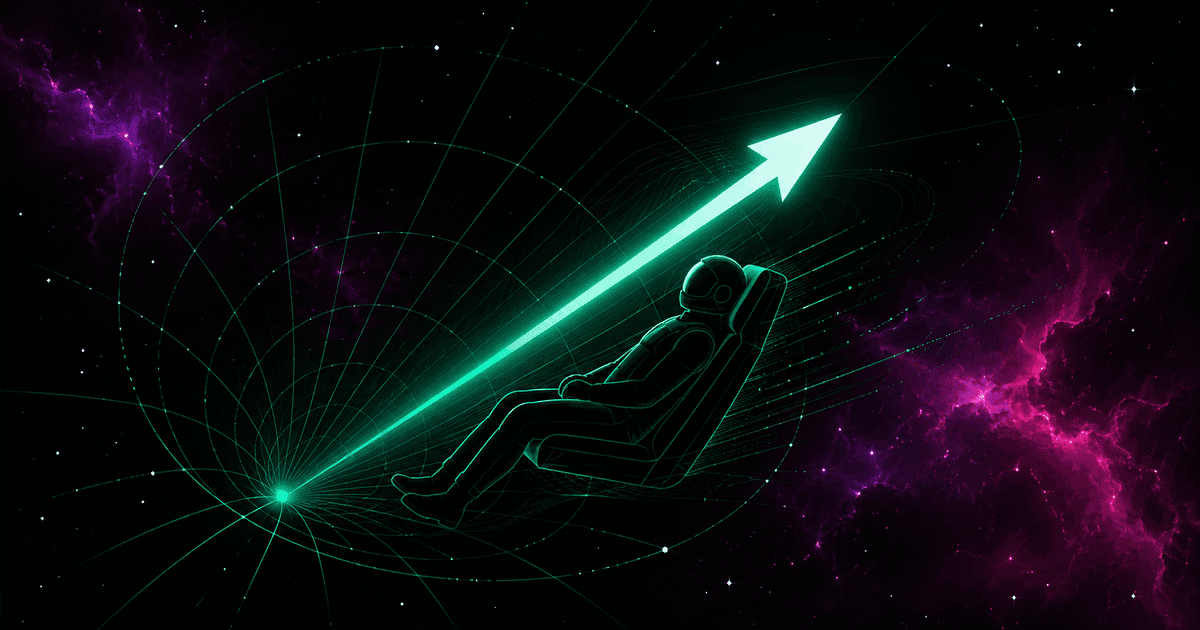
During a jet's takeoff, every passenger feels the same distinct push into the seatback. But once the aircraft reaches a steady cruising speed — around 900 km/h — the sensation vanishes without a trace. Pouring a coffee ten kilometers up is no harder than in your kitchen at home. This small fact hides one of the deepest truths in mechanics: the human body is completely indifferent to speed, whatever its value. We react only to its change over time — that is, to acceleration.
That's why a smooth flight lets you doze off, while a few-second climb to the top of a roller-coaster loop floods your blood with adrenaline. We aren't afraid of speed. We're afraid of its sudden changes.
The second, squared
In everyday language "speed" and "acceleration" get confused, though they mean different things. Speed tells you how fast a body changes its position. Acceleration tells you how fast the speed itself changes. Formally, average acceleration is the ratio of the change in speed to the time in which that change occurred: a = Δv / Δt.
The SI unit is the meter per second squared (m/s²). That notation can be misleading — "a second squared" sounds abstract. The resolution appears when you write the unit as a stacked fraction: (m/s) / s. Acceleration therefore tells you by how many meters per second the speed changes during each successive second. A vehicle with a constant acceleration of 3 m/s² is doing 3 m/s after the first second, 6 m/s after the second, and 9 m/s after the third. The second appears twice: once inside the speed itself, and once as the duration of its change.
Where does the physical sensation come from? From Newton's second law: F = m · a. The force acting on a body is proportional to its acceleration. It is force — exerted by the seat, the belts, the vehicle's structure — that stresses tissues and puts the circulatory system to work. At constant mass, every change of speed or direction instantly becomes a concrete mechanical load.
A decree, not a measurement: where 9.80665 came from
In engineering and aviation, acceleration is often given in units of g, referring to the acceleration due to gravity. We associate it with the rounded value 9.81 m/s². But in precise calculations and instrument calibration, an exactly defined value applies:
gₙ = 9.80665 m/s²
This number is not the result of any single, ideal measurement. It is a conventional value, adopted by the 3rd General Conference on Weights and Measures (CGPM) in 1901 as part of Declaration 2 on the unit of mass and the definition of weight. The goal was to unify metrology: local gravity varies from place to place on the globe, so without a common standard, precise weighing and the definition of force units would have no single reference. The basis was measurements made at the Pavillon de Breteuil near Paris, brought by a theoretical correction to latitude 45° at sea level.
Thanks to this fixed constant, the kilogram-force and pound-force could be unambiguously defined. For the imperial system it converts directly to feet per second squared using the definition of the foot (1 ft = 0.3048 m):
1 g = 9.80665 / 0.3048 ≈ 32.174 ft/s²
Engineering calculations use exactly this rounded 32.174 ft/s². There is one standard, and it does not depend on where the laboratory stands.
The Earth is not a perfect sphere
Although 9.80665 m/s² works well as an official reference, the real acceleration at the Earth's surface changes from place to place — by about 0.5% at the extremes. According to the Geodetic Reference System 1980 (GRS80), normal gravity is roughly 9.780 m/s² at the equator and 9.832 m/s² at the pole. Two factors are responsible.
First, the flattening of the Earth. Our planet is not a sphere but an ellipsoid flattened at the poles: the equatorial radius is about 6,378 km, the polar radius about 6,357 km — a difference of over 21 km. At the pole we are closer to the center of mass, so the pull there is stronger.
Second, the centrifugal force of the Earth's rotation. It acts against gravity and peaks at the equator, where the surface's linear speed is greatest; at the pole, on the axis of rotation, it disappears. So the effective acceleration at the equator is reduced further still.
For subtle measurements, meters per second squared can be inconvenient, so gravimetry uses units from the CGS system, named after Galileo:
1 Gal = 1 cm/s² = 0.01 m/s², and 1 mGal = 10⁻⁵ m/s².
Milligals make it possible to detect density anomalies underground: heavy metal ores raise the local pull by fractions of a milligal, while lighter deposits of salt, gas, or oil produce negative anomalies. The dependence on altitude is described by the free-air correction, about −0.3086 mGal per meter (−3.086 × 10⁻⁶ m/s²/m).
These anomalies are even scanned from orbit. The twin satellites of the NASA/GFZ missions — GRACE, then GRACE-FO — orbit one behind the other about 220 km apart. When the leading one passes a region of greater mass density, it is pulled harder and speeds up, changing the distance between the satellites. GRACE-FO measures these variations with a laser interferometer accurate to about 10 nanometers, which is how we can "see" the melting of Greenland's glaciers or changes in groundwater levels.
G-force is not gravity
The most common misconception is equating gravity with g-force. Despite the name, g-force is not a gravitational force but a dimensionless ratio of proper acceleration to the standard gₙ. The key lies in distinguishing two concepts.
Coordinate acceleration is the change of speed relative to an external frame of reference — what we compute when a car accelerates from 0 to 100 km/h on the road.
Proper acceleration is the acceleration measured relative to an observer in free fall. A physical accelerometer registers it, and it is what accounts for the felt weight and the stresses on the body.
According to general relativity, a gravitational field alone produces no proper acceleration. A body in free fall — a skydiver in the first phase of the jump, a satellite in orbit — experiences no mechanical force, and its accelerometer reads 0 g, despite a large coordinate acceleration relative to the Earth. That is weightlessness. Conversely, a person standing still on the ground has zero coordinate acceleration but experiences +1 g pointing upward. It isn't gravity "pulling" us down — it's the hard ground pushing on our feet, preventing us from following the natural curve toward the center of the Earth. G-force always comes from contact: the push of the floor, the seat, the harness, air resistance — never from gravity itself.
The scale of acceleration and the human limit
The table below lists typical values in m/s² and in multiples of g.
| Event | Acceleration (m/s²) | G-force (g) | Note |
|---|---|---|---|
| Slow elevator start | 0.5–1.0 | 0.05–0.10 | At the edge of perception |
| Airliner takeoff | 2–4 | 0.2–0.4 | Limited by passenger comfort |
| Car braking | 4–8 | 0.4–0.8 | Bounded by tire friction |
| Formula 1 braking | 40–60 | 4–6 | Aerodynamic downforce + carbon brakes |
| Saturn V rocket launch | ~38 | ~3.9 | Just before first-stage separation |
| Hard F-16 fighter turn | ~74 | ~7.5 | Requires an anti-G suit |
| Pilot tolerance limit | ~88 | ~9 | Centrifuge test: 9 g for 15 s |
| Col. John Stapp's record | ~453 | 46.2 | Max survived by a human (1954) |
A few numbers are worth unpacking. When a car accelerates from 0 to 100 km/h in 5 seconds, the change in speed is about 27.78 m/s, so the average acceleration is 27.78 / 5 ≈ 5.56 m/s². Divided by 9.80665, that gives about 0.57 g — noticeable but comfortable. It's a different story in a fighter cockpit in a tight turn, where the vector runs along the head-to-feet axis. At +9 g, blood becomes nine times "heavier," the heart cannot push it up to the brain, and oxygen starvation sets in: first peripheral vision fades (tunnel vision), then color (grayout), then sight (blackout), and finally consciousness (G-LOC). Pilots counter this with the AGSM maneuver — a synchronized tensing of the leg and abdominal muscles plus a special breathing technique with a partly closed glottis, which raises the pressure in the chest.
But there are limits training alone cannot beat. Colonel John Stapp, a US Air Force flight surgeon who personally tested tolerance to extreme deceleration, showed as much. On 10 December 1954, on the Sonic Wind I rocket sled, he accelerated to 1,017 km/h in 5 seconds, then braked to zero in 1.4 seconds, experiencing a momentary g-force of 46.2 g. The force forced his eyes into their sockets and burst the capillaries in his eyeballs, causing temporary blindness — but he survived, proving that a properly restrained body can withstand far more than the limits of the day assumed.
Three myths under the lens
"The acceleration due to gravity is always 9.81 m/s²." That is just a rounding of the conventional constant 9.80665 m/s². The real value depends on latitude and altitude. The fixed figure is kept for practical reasons: spring scales are calibrated to gₙ, so without a common standard, a kilogram of poppy seeds weighed in Oslo and in Kuala Lumpur would give different commercial results.
"Astronauts float because there's no gravity in space." The International Space Station orbits at about 420 km. Gravity there is gₙ · (6371 / (6371 + 420))² ≈ 8.63 m/s², a full 88% of the sea-level value. The Earth holds the station firmly. Astronauts float because they are in a state of perpetual free fall: the station races along at about 27,600 km/h and falls toward the Earth at exactly the rate the surface "curves away" beneath it. They fall together with the crew, with no ground reaction force — so their proper acceleration is zero.
"Galileo dropped balls from the Leaning Tower of Pisa." Historians treat this anecdote skeptically: the only source is a biography written by his student Vincenzo Viviani in 1654, more than half a century after the supposed demonstration. Galileo himself never mentions it — and, knowing that free fall is too fast for the timers of his day, he studied motion on inclined planes, measuring time with a water clock and his own pulse. The decisive proof came only from the Moon: in 1971, Apollo 15 astronaut David Scott dropped a heavy hammer (1.32 kg) and a falcon feather (0.03 kg) on camera. In the vacuum, both struck the ground at the same instant, confirming a hypothesis centuries old.
We feel only the change
It all comes down to one principle: speed is relative, but acceleration is absolute. We have no sense that detects steady, uniform motion — whether we're walking or racing through orbit at tens of thousands of kilometers per hour. What we do have is a precise biological accelerometer: the vestibular system of the inner ear and the receptors of deep sensation, which instantly raise the alarm at any attempt to change that state. The units of acceleration — m/s², ft/s², g and gals — are handled by the acceleration converter; speed itself, the imperceptible kind, gets a piece of its own: knots, Mach and kilometers per hour.
That is why a flight ten kilometers up lets you relax, while a few seconds atop a roller-coaster loop triggers a rush of adrenaline. Inertia is then trying, quite literally, to leave its mark on your body — and it is that change, not the speed, that we feel.
Further reading
- BIPM, The International System of Units (SI Brochure), 9th ed. (2019) — unit definitions and CGPM resolutions, including standard gravity.
- Declaration 2 of the 3rd CGPM (1901) — the source text adopting the value 9.80665 m/s².
- NASA, Apollo 15 Preliminary Science Report (SP-289) — mission documentation, including the hammer-and-feather experiment.
- NASA / GFZ, the GRACE / GRACE-FO mission — measuring the Earth's gravity anomalies from orbit.
- The biography and experiments of Col. John Stapp — research into the limits of human tolerance to g-force.