
The height of a tower, the width of a river, the distance to a ship offshore — all of it can be computed without going anywhere near the thing being measured. An angle and one distance you can walk with a tape are enough. The whole of trigonometry rests on a single observation: in a right triangle the ratio of two sides depends only on the angle, not on how big the triangle is. That is what turns an angle into a number, and a number can be worked out once and written into a table. This piece is the narrative layer above our trigonometry branch: where sine, cosine and tangent came from, and why they work at all.
The observation that turns an angle into a number
Take a right triangle and point at one of its acute angles, α. The sides then get names: the hypotenuse c lies opposite the right angle, the leg a opposite α, and the leg b next to it. The three basic ratios are:
sin α = a / c— opposite leg over hypotenuse,cos α = b / c— adjacent leg over hypotenuse,tan α = a / b— opposite over adjacent.
The names of the sides belong to the angle, not the triangle — and that is the first trap. The very leg that is opposite for α becomes the adjacent one for the other acute angle, β = 90° − α. Hence sin α = cos β, which is not a separate rule but the same drawing read from the other end.
Why, though, does the value of such a ratio not depend on the size of the figure? Because two right triangles sharing an acute angle α automatically have the same set of angles: 90°, α and 90° − α. That makes them similar in the angle-angle-angle sense, and in similar triangles the ratios of corresponding sides are equal. The scale cancels. A triangle drawn on paper and a triangle spanning three mountain peaks have exactly the same sine for the same angle.
That is the entire trick, and it runs deeper than it looks. As long as you measure triangles, you have to reach them. Once the ratio of sides stops depending on size, the angle becomes a number — and a number can be tabulated, so that nobody ever has to draw that triangle again. The definitions and the first calculations are laid out in the lesson on sine, cosine and tangent.
It began in the sky, not on a building site
Trigonometry's first home was not plane geometry but astronomy. Ancient observers wanted to tie arcs on the celestial sphere to angles — and they had no notion of a function in our sense. They worked with something more tangible: the chord (Greek khordē) of a circle of fixed radius, subtending a given arc.
The first table of chords is attributed to Hipparchus of Nicaea (c. 190–120 BCE) and dated to around 140 BCE. The work itself has not survived; that it ran to twelve books we know from the commentary on the Almagest written by Theon of Alexandria in the fourth century CE — half a millennium after the fact. It is a good illustration of what the documentary basis looks like for most "certainties" about ancient mathematics.
What has survived is the Almagest — the treatise by Claudius Ptolemy of Alexandria from the second century CE, originally Mathēmatikē Syntaxis. Ptolemy divides the circle into 360 degrees and its diameter into 120 parts, and lists chord lengths for angles from ½° to 180° in half-degree steps. To fill that table he used his own theorem on cyclic quadrilaterals, from which he derived the equivalents of today's formulas for the sine of a sum, a difference and a half-angle.
The conceptual breakthrough came from India. In the Aryabhatiya of 499 CE, Aryabhata replaces the full chord of the doubled angle with half of it — and that is already precisely our sine. In Sanskrit the segment was called ardha-jya, "half-chord", soon shortened to jya.
| Era and culture | Term | What it actually meant |
|---|---|---|
| Greece (Hipparchus, Ptolemy) | khordē | the length of the whole chord subtending a central angle |
| India (Aryabhata, 5th c.) | ardha-jya → jya | half the chord of the doubled angle — today's sine |
| Islamic world (8th–12th c.) | jiba → read as jaib | the vowel-less transliteration jb, read as the word for "fold" |
| Latin Europe (12th c.) | sinus | a literal rendering of jaib: bay, hollow, fold of a garment |
Sine, meaning bay — the anatomy of a slip
In the eighth century, during the great wave of translation in Baghdad, Indian astronomical works were rendered into Arabic. The Sanskrit jya was carried over phonetically as jiba, written in consonants as jb (جيب). The word meant nothing in Arabic, and the Semitic script does not record short vowels — so successive generations of readers saw in those letters an existing word, jaib: "fold of a garment", "pocket", "bay".
When these texts were translated from Arabic into Latin in the twelfth century, jaib was rendered literally: sinus, which is exactly a bay, a hollow, the fold of a toga. The translation is usually credited to Robert of Chester (1145), though Gerard of Cremona (1150) is sometimes named instead — the attribution is not certain. The term settled once Fibonacci used it in the form sinus rectus arcus.
It is worth being clear about what this "translator's mistake" was and was not. It was not carelessness: with unvocalised script, reading a loanword as a native homograph is entirely natural behaviour. And it was not without consequence — to this day the most important periodic function in mathematics is named after an item of clothing.
The history of the other names also runs differently from the usual telling. Astronomers of the Islamic world such as al-Battani and Abu al-Wafa did indeed compute tables of the shadow functions — the length of the shadow cast by a sundial's gnomon, in Latin umbra recta and umbra versa. Those are the ancestors of tangent and cotangent, but not their names: tangens and secans were introduced only by Thomas Fincke in Geometria rotundi (1583), and the forms cosinus and cotangens were proposed by Edmund Gunter around 1620. Six hundred years separate the function from its surname here.
The last two steps are modern. John Napier's logarithms (1614) produced the logarithmic-trigonometric tables in which multiplying function values reduced to adding their logarithms — the standard computational technique of engineering right up to the calculator. And Leonhard Euler, in Introductio in analysin infinitorum (1748), did the decisive thing: he treated sine and cosine not as segments in a circle of some radius but as dimensionless functions of a real variable — and wrote e^(ix) = cos x + i·sin x.
An exact value is not a table reading
For three angles the values of the trigonometric functions are derived rigorously, by elementary geometry — with no table involved.
For 45° take an isosceles right triangle with legs a = b = 1. By the Pythagorean theorem c = √2, so sin 45° = 1/√2 = √2/2, the cosine is the same, and tan 45° = 1.
For 30° and 60° take an equilateral triangle of side 2 and cut it with an altitude. The result is a right triangle with angles 30° and 60° in which the shorter leg is 1, the hypotenuse is 2, and the altitude — again by Pythagoras — is h = √(4 − 1) = √3. From which, immediately, sin 30° = 1/2 and cos 30° = √3/2.
| Angle | rad | sin exact | sin ≈ | cos exact | cos ≈ | tan exact | tan ≈ |
|---|---|---|---|---|---|---|---|
| 0° | 0 | 0 | 0.0000 | 1 | 1.0000 | 0 | 0.0000 |
| 30° | π/6 | 1/2 | 0.5000 | √3/2 | 0.8660 | √3/3 | 0.5774 |
| 45° | π/4 | √2/2 | 0.7071 | √2/2 | 0.7071 | 1 | 1.0000 |
| 60° | π/3 | √3/2 | 0.8660 | 1/2 | 0.5000 | √3 | 1.7321 |
| 90° | π/2 | 1 | 1.0000 | 0 | 0.0000 | undefined | — |
The left column of each pair is the value; the right one is its rounding. The difference is not cosmetic: √3/2 substituted into a further calculation introduces no error at all, whereas 0.87 introduces one immediately, and in a longer computation that error grows. Round at the end, not halfway.
Away from the special angles the values are irrational and have to be computed numerically. The boundary of what counts as "nice" is in fact sharply defined: Niven's theorem says that if an angle is a rational multiple of a full turn, its sine is rational only in the cases 0, ±1/2 and ±1. While we are here, one frequently mangled claim is worth fixing: such values are irrational but algebraic — they satisfy a polynomial equation with integer coefficients. Transcendence only enters for sines of angles whose radian measure is algebraic, such as sin 1.
The unit circle: an angle without limits
The triangle definition has a built-in ceiling — it only accommodates acute angles. Extending it to all real numbers is what the unit circle is for: a circle of radius r = 1 centred at the origin. Let the radius vector make an angle θ with the positive x axis, and let P = (x, y) be the point where it meets the circle. Then simply:
cos θ = x, sin θ = y, tan θ = y / x (for x ≠ 0)
For an acute angle this is exactly the old definition, because the hypotenuse has length 1 and the denominators vanish. What is new is that nothing stops P from leaving the first quadrant — and the signs of the functions then follow straight from the signs of the coordinates: in the second quadrant only sine is positive, in the third only tangent, in the fourth only cosine. A positive angle is a counter-clockwise rotation, a negative one is clockwise, and an angle above 360° is simply more than one full lap. The full picture, with a drawing, is in the lesson on the unit circle.
This also settles the question of how to measure an angle in the first place. Dividing a full turn into 360 parts is a convention of Babylonian ancestry, whose advantage is that 360 has 24 divisors and so splits without fractions (we cover it separately in our piece on 360 degrees). The radian is different: it is the ratio of arc length to radius, θ = s / r, hence a dimensionless number. When the arc equals the radius the angle is 1 radian, about 57.2958°; a full turn is 2π radians.
That difference is not a matter of taste. The formulas of calculus — lim(x→0) sin x / x = 1 and (sin x)' = cos x — hold only in radians. In degrees the derivative of sine picks up a factor of π/180, and that is exactly what radians exist for: to remove an artificial constant from differential calculus. In the other direction, for practical work, degrees and radians are converted by the angle converter.
The Pythagorean identity is Pythagoras on a circle
The most important trigonometric identity needs no new idea at all — it is enough to write the equation of the unit circle, x² + y² = 1, and substitute x = cos α, y = sin α. Out comes:
sin²α + cos²α = 1
That is all. The Pythagorean identity is the Pythagorean theorem transferred onto a circle of radius 1, and that is precisely why it holds for every real α — including negative ones and ones larger than a full turn, where there is no right triangle left to speak of. The applications (recovering the cosine from a known sine plus the sign of the quadrant) are collected in the lesson on the Pythagorean identity, and the geometric proof itself in the lesson on the Pythagorean theorem.
When there is no right angle
All the ratios above require a right angle. In an arbitrary triangle two more general laws apply.
The law of sines says that the ratio of a side's length to the sine of the angle opposite it is constant within a given triangle — and equal to the diameter of its circumscribed circle:
a / sin α = b / sin β = c / sin γ = 2R
It is used when two angles and a side are known, or two sides and an angle opposite one of them. In the second case care is needed: "two sides and a non-included angle" may describe two different triangles, because sin(180° − α) = sin α. This is the well-known ambiguous case, where the equation alone is not enough and you have to check which result is consistent with the rest of the data.
The law of cosines ties three sides to one angle:
c² = a² + b² − 2ab·cos γ
It is a direct generalisation of the Pythagorean theorem: for γ = 90° we have cos 90° = 0, the correction term vanishes, and c² = a² + b² is left. It applies when two sides and the angle between them are known, or all three sides. Both laws are discussed in full in the lesson on the laws of sines and cosines.
Example: a tower's height from two stations
From point A the angle of elevation of a tower's top is 30°. After moving 50 m closer, to point B, the angle rises to 45°. The base of the tower is inaccessible. Let h be the height and x the distance from B to the base.
From station B: tan 45° = h / x = 1, so x = h. From station A the distance is h + 50, so tan 30° = h / (h + 50). Substituting the exact value tan 30° = √3/3:
√3/3 = h / (h + 50) ⟹ √3·(h + 50) = 3h ⟹ 50√3 = h·(3 − √3)
Rationalising the denominator, h = 50√3 / (3 − √3) = 25(√3 + 1) m. That is the exact result; only now does it become h ≈ 68.3 m.
Example: the distance between two islands
A ship at point C sees islands A and B at an angle of γ = 60°; the distances are 6 km and 10 km. By the law of cosines:
c² = 6² + 10² − 2·6·10·cos 60° = 36 + 100 − 120·0.5 = 76
so c = √76 = 2√19 ≈ 8.72 km. Note that cos 60° = 1/2 is an exact value here — the whole calculation stays in whole numbers until the last step.
From rotation to wave
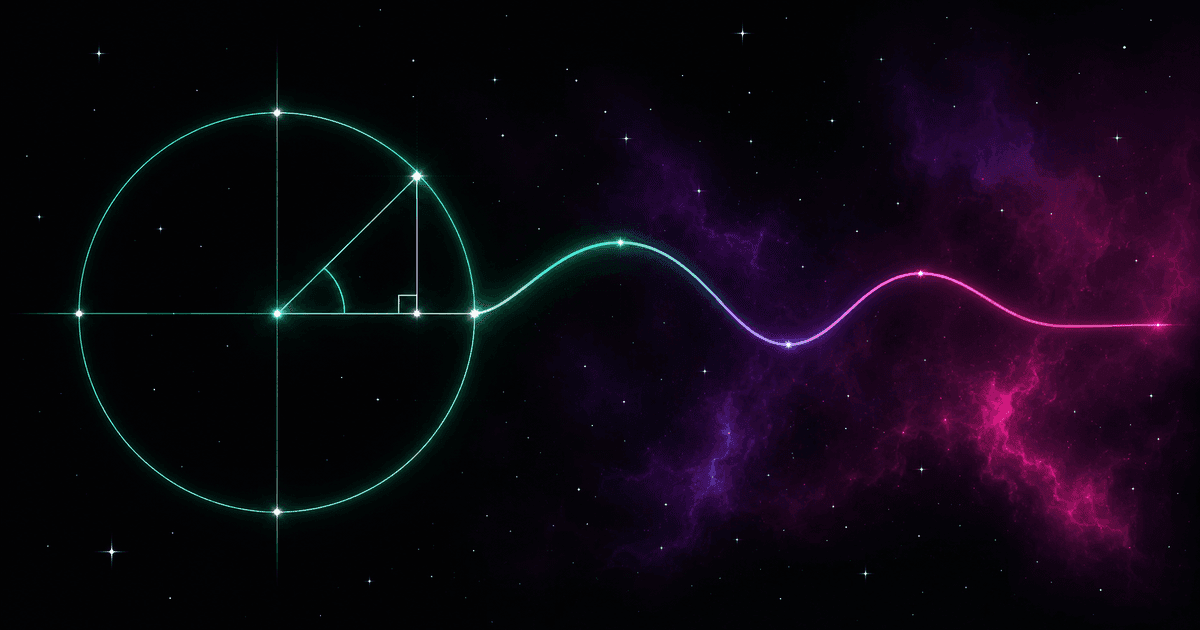
Send a point around the unit circle at constant angular velocity and follow one coordinate over time. You get a sinusoid: the same circle, only unrolled along an axis. The functions y = sin x and y = cos x have period 2π and range [−1, 1], and the general harmonic wave is
y(t) = A·sin(ωt + φ) + D
where A is the amplitude, ω = 2π/T the angular frequency, φ the phase shift, and D the midline. Four parameters, and the entire wealth of oscillation follows — from sound (changes in air pressure) through mains voltage (50 Hz in Europe, 60 Hz in North America) to a pendulum at small displacements and the ocean tides. How those parameters translate into the shape of the graph is shown in the lesson on trigonometric graphs.
The real power of this description, however, comes from Fourier analysis: a periodic signal — under fairly mild assumptions about its regularity — decomposes into a sum of pure sines and cosines of different frequencies, amplitudes and phases. That is where JPEG and MP3 compression come from, both built on the discrete cosine transform, and where all digital audio processing comes from. In three-dimensional graphics the same functions sit inside rotation matrices, and in surveying they sit inside triangulation, where the height of an inaccessible peak is found exactly as in the tower example, just at a larger scale.
One caveat, because a popular inaccuracy circulates here: GPS does not work with angles. The receiver measures the travel times of signals from at least four satellites, converts them into distances, and fixes the position by trilateration — the intersection of spheres. Trigonometry enters only when the result is converted into geographic coordinates — but it enters in its spherical form, which is where this whole story began.
The five most expensive mistakes
| Mistake | Where it comes from | How it actually works |
|---|---|---|
| Swapping the opposite leg for the adjacent one | names attached to the triangle, not the angle | the same leg is opposite for α and adjacent for β |
| Right-triangle ratios in an oblique triangle | the right-angle assumption ignored | with no right angle only the law of sines or cosines works |
| DEG versus RAD mode on the calculator | whatever the device defaults to | sin 30° = 0.5, but sin(30 rad) ≈ −0.988 |
Rounding √3/2 to 0.87 mid-calculation | the reflex that "a number needs a decimal point" | carry the exact value to the end, round only afterwards |
Reading a 100% gradient as vertical | percentage taken for a fraction of a full turn | 100% means tan α = 1, that is 45° |
What is convention and what is truth
| Element | Nature | Why |
|---|---|---|
| Dividing a turn into 360° | convention | a Babylonian inheritance; 360 has 24 divisors, so it splits without fractions |
| The names "sine", "tangent", "cosine" | convention | a 12th-century translation through a homograph plus 16th–17th-century Latin |
| The radian as a measure of angle | natural convention | a choice of unit, but the only one under which (sin x)' = cos x |
The constancy of a/c for a given angle | truth | a consequence of triangle similarity (the angle-angle-angle criterion) |
sin 30° = 1/2 | truth | follows from bisecting an equilateral triangle, with no measurement at all |
sin²α + cos²α = 1 | truth | the Pythagorean theorem on the unit circle |
c² = a² + b² − 2ab·cos γ | truth | a generalisation of Pythagoras; for γ = 90° it reduces to it |
The names of the trigonometric functions, then, are an accident; the unit of angle is a decision; the tables are a convenience. Only one thing here is beyond dispute: that the ratio of two sides in a right triangle knows nothing about the size of that triangle. Noticing it was enough to measure the distance to the Moon without moving from the spot.
Further reading
- Glen Van Brummelen, The Mathematics of the Heavens and the Earth: The Early History of Trigonometry, Princeton University Press 2009 — the most reliable monograph on the subject's early history.
- Eli Maor, Trigonometric Delights, Princeton University Press 1998 — essays on periodic functions and their applications.
- Claudius Ptolemy, Almagest — G. J. Toomer's English translation (Princeton University Press 1998), with the table of chords from Book I.
- MacTutor History of Mathematics Archive, University of St Andrews — the entry Trigonometric functions and the biographies of Hipparchus and Ptolemy.
- Jeff Miller, Earliest Known Uses of Some of the Words of Mathematics (in the MacTutor archive) — documented first-use dates for tangens, secans and cosinus.
- Khan Academy — the trigonometry course (khanacademy.org).
- Delta (deltami.edu.pl) — accessible articles on periodic functions and spherical trigonometry.