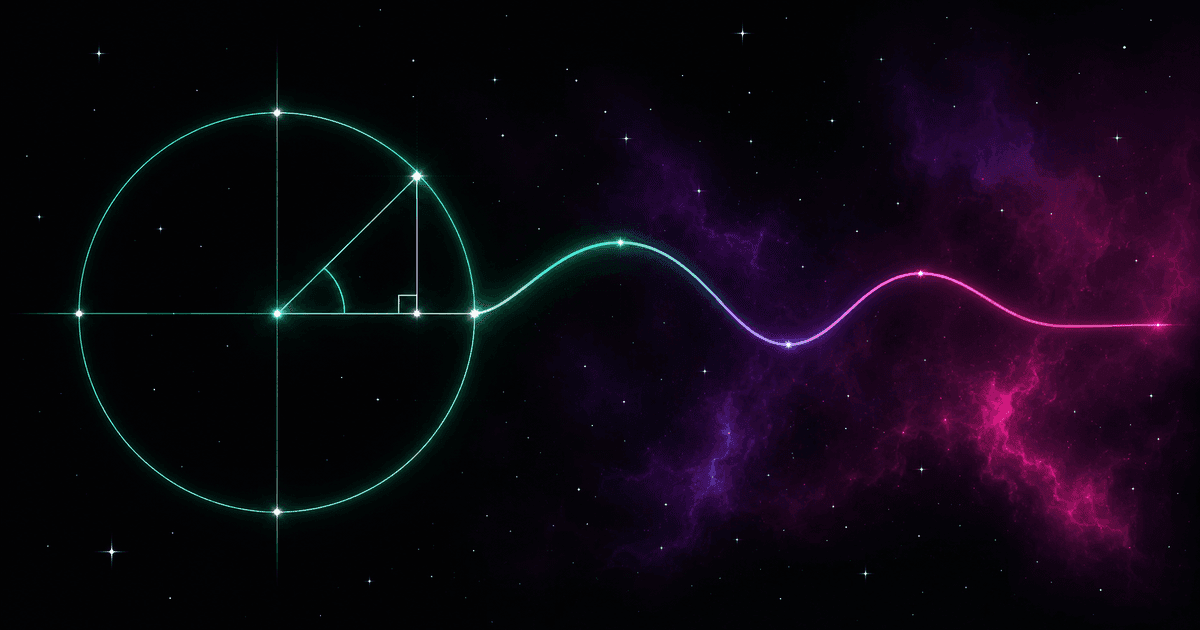
The unit circle
The unit circle carries the sine and the cosine from a triangle onto the whole circle. See how the coordinates of a point become the values of the functions, what signs they take in the four quadrants, and what a negative angle or one past a full turn means.
Before you start
This topic builds on earlier ideas. Before you start, it's worth working through the lessons below — they'll make everything click:
- Sine, cosine and tangentSine, cosine and tangent are three ratios of the sides of a right triangle. See why they depend on the angle alone, where the exact values for 30°, 45° and 60° come from, and how to find a side you cannot measure.
- Area and circumference of a circleThe area of a disc is A = πr², its circumference is C = 2πr. See what the number π actually is, how the radius relates to the diameter, why the answer nearly always has to be rounded, and how a circle differs from a disc.
Where this is used
Real situations where you count exactly the way this lesson teaches:
- The workshopSix holes spaced evenly on a circle of radius 12 cm sit 60° apart. Rather than bending a tape along the arc, work out the coordinates: the third hole falls at 120°, that is at (12 · cos 120°, 12 · sin 120°) = (−6 cm, 10.4 cm). The minus sign says it lies 6 cm to the left of the centre, and measuring along two perpendicular directions lands it to the millimetre.
- Computer graphicsEvery "rotate by 15°" is this one calculation run over all the pixels. A point 100 px from the centre, turned by 210°, ends up at (100 · cos 210°, 100 · sin 210°) = (−86.6, −50). No right triangle has an angle of 210°; on the unit circle the answer simply comes out as two negative coordinates, because the point is in the third quadrant.
- Stepper motorsA motor with 200 steps per revolution turns its shaft by 360° / 200 = 1.8° a step, but controllers and motion libraries take radians: 1.8° = π/100 ≈ 0.0314 rad, and a full turn is 2π ≈ 6.283 rad. Send 1.8 instead of 0.0314 and the move comes out 57 times too big — that being how many degrees there are in one radian.
All formulas
Equation of the unit circle
a circle centred at (0, 0) with radius 1
The point on the circle
the cosine is the x-coordinate, the sine the y-coordinate
Coterminal angles
a full turn changes nothing
The right-triangle definitions have one limitation: a triangle only has acute angles, so means nothing in them. The unit circle removes that limitation — and shows, along the way, what the sine and the cosine really are.
A circle of radius 1
Draw a circle centred at with radius :
The angle is measured from the positive semi-axis, counter-clockwise. Its arm meets the circle in exactly one point .
For an acute angle this is exactly the triangle definition. The radius, its projection onto the axis and the vertical segment form a right triangle whose hypotenuse is , so
A radius of one removes the division — only the coordinates are left. What is new is that the point can be turned past and its coordinates still exist.
Signs in the quadrants
The axes split the plane into four quadrants, numbered counter-clockwise. The sign of a function is simply the sign of the matching coordinate.
| quadrant | range | |||
|---|---|---|---|---|
| I | – | |||
| II | – | |||
| III | – | |||
| IV | – |
The tangent is a quotient, so its sign follows from the other two: two minus signs in the third quadrant make a plus.
Values outside the first quadrant
Take the numeric value from the reference angle — the acute angle between the arm and the axis — and the sign from the quadrant.
Negative angles and extra turns
Nothing forces us to stop at . A negative angle is measured clockwise, and an angle past a full turn simply lands where it has already been:
Angles leading to the same point are called coterminal. Hence , while , because turning the other way flips the sign of the -coordinate.
The other measure of an angle
An angle can be measured in something other than degrees. The same quarter circle is or radians — a measure in which the size of an angle is the length of the arc it cuts, rather than a convention about splitting a turn into 360 parts. That is the measure the rest of this branch uses, and the one the axes of the trigonometric graphs are scaled in; the definition, both conversions and the formulas for arc length and sector area are a topic of their own: radian measure.
Exercises
For a value of a function, type the exact value, e.g. √2/2 or −1/2. For a quadrant, give its number as a Roman numeral: I, II, III or IV.
Practice
Work through a set of exercises — they get harder as you go. At the end you'll see your score and the mistakes worth reviewing.
Common mistakes
- Measuring the angle from the axis — an angle always starts at the positive semi-axis.
- Swapping sine and cosine — the cosine is the horizontal coordinate, the sine the vertical one. Alphabetically: cosine before sine, just as comes before .
- Losing the sign in quadrants II–IV — the value comes from the reference angle, but the sign comes from the quadrant.
- Confusing the quadrant with the reference angle — lies in quadrant III, but its reference angle is ; two different numbers answering two different questions.
- Looking for the quadrant before reducing to one turn — and are the same arm as , which is quadrant I.
- A sine greater than 1 — impossible on a circle of radius 1; such a result means an error in the arithmetic.
Formula card
Topic: The unit circle
Equation of the unit circle
a circle centred at (0, 0) with radius 1
The point on the circle
the cosine is the x-coordinate, the sine the y-coordinate
Coterminal angles
a full turn changes nothing