Trigonometry
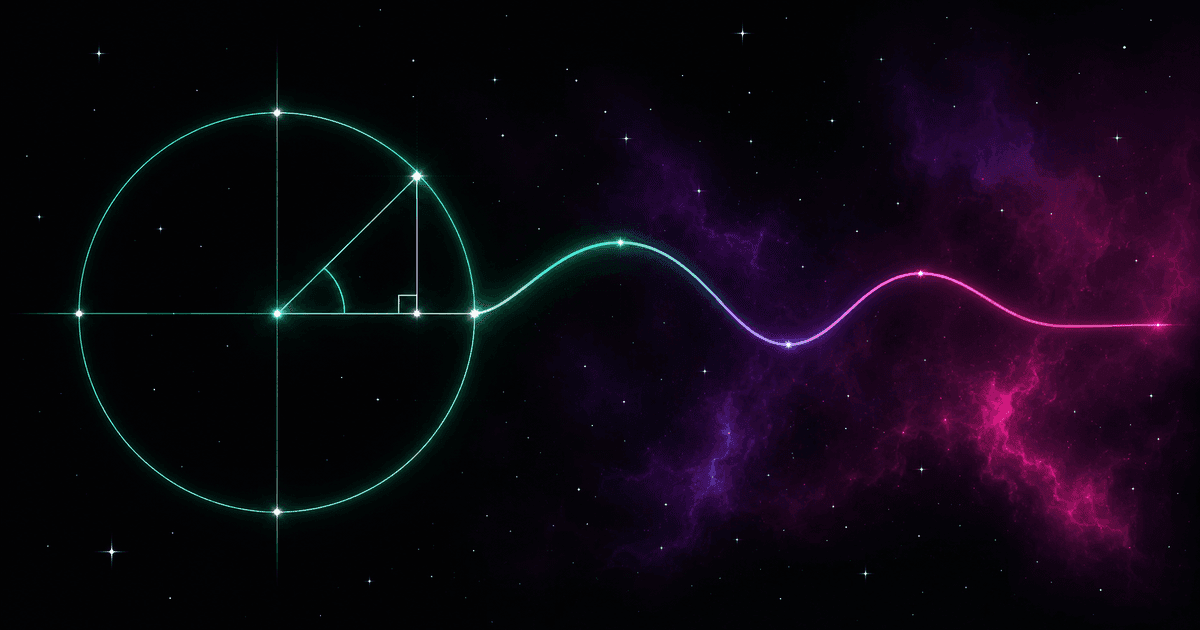
Sine, cosine and tangent — from the right triangle to the unit circle: a height and a gradient from one angle, and then everything that repeats.
Topics in this branch
Why this branch is worth learning
Every topic here settles a real situation. One example from each lesson:
- Wheelchair rampsThe step up to the terrace is 45 cm and a wheelchair needs a ramp no steeper than 6%. A gradient is the tangent of the angle, so tan α = 0.06, meaning α ≈ 3.4°, and the horizontal run comes to 45 cm / 0.06 = 750 cm. The ramp has to be 7.5 m long — usually more than the space in front of the terrace, which is why such ramps end up as two shorter flights with a landing.
- The workshopSix holes spaced evenly on a circle of radius 12 cm sit 60° apart. Rather than bending a tape along the arc, work out the coordinates: the third hole falls at 120°, that is at (12 · cos 120°, 12 · sin 120°) = (−6 cm, 10.4 cm). The minus sign says it lies 6 cm to the left of the centre, and measuring along two perpendicular directions lands it to the millimetre.
- RoofingPlans give the pitch of a roof as a percentage: 40% means tan α = 0.40. The identity 1 + tan²α = 1/cos²α turns that into cos α = 1/√1.16 = 0.93, so the slope above a 6 m span measures 6 / 0.93 = 6.46 m. Order sheeting off the plan width and every course falls 46 cm short — and no protractor came near the roof.
- Fencing a plotTwo sides of a plot run 12 m and 9 m and meet at 115°. The law of cosines closes the corner: √(12² + 9² − 2 · 12 · 9 · cos 115°) = √(225 + 91.3) = 17.8 m. The cosine of an obtuse angle is negative, so the subtraction turns into an addition — 2.8 m more fencing than the 15 m a square corner would have needed.
- Mains electricityMains voltage does not sit at 230 V — it runs along a sine, u(t) = 325 · sin(2π · 50 · t). The 230 V figure is the peak divided by √2, so the wires really do carry 325 V at the top of each swing. At 50 Hz one period lasts 0.02 s and the voltage passes through zero 100 times a second, which is the 100 Hz flicker you catch out of the corner of your eye in cheap LED bulbs.
- The socket in the wallMains voltage runs as a sine, u(t) = 325 · sin(ωt), where ω = 2π · 50 Hz ≈ 314 rad/s. Four milliseconds after a zero crossing the angle is 314 · 0.004 = 1.256 rad and the voltage is 325 · sin(1.256) ≈ 309 V. The calculator has to be in RAD mode for that: in DEG it computes sin 1.256° ≈ 0.022 and answers 7 V instead of 309 V.
- Noise-cancelling headphonesA microphone picks up engine noise of amplitude 40 mPa and the speaker plays the same tone shifted by 180°: sin(x + 180°) = −sin x, so the reproduced wave is exactly opposite. The sum 40 · sin x + 40 · sin(x + 180°) = 0 — silence. Active noise cancellation is one reduction formula, executed 48,000 times a second.
- Projectile rangeThe range of a projectile launched at speed v and angle α is R = v² · sin 2α / g — a formula that comes straight out of the double-angle identity. For v = 20 m/s and α = 30° that is 400 · sin 60° / 9.81 = 35.3 m, and for α = 45° it is 40.8 m. Since sin 2α peaks at 2α = 90°, the best launch angle is always 45° — which is why a shot put flies furthest at exactly that angle.
- TidesThe depth in a harbour varies as h(t) = 2.5 + 1.8 · sin(2πt/12.4) metres, with t in hours. A yacht drawing 3.4 m can enter when sin(2πt/12.4) ≥ 0.5, that is when 2πt/12.4 lies between π/6 and 5π/6 — a window from t = 1.03 h to t = 5.17 h, four hours and eight minutes of high water. Harbour authorities publish exactly this number as the "tidal window".
- Road gradientsA road sign reading "8%" means the road climbs 8 m over 100 m of horizontal distance. The angle is arctan 0.08 = 4.57°. A 12% climb is arctan 0.12 = 6.84°, and the maximum permitted gradient of a wheelchair ramp (6%) corresponds to arctan 0.06 = 3.43°. Without the arctangent a percentage cannot be turned into an angle at all.
Branch formulas
Branch: Trigonometry
Sine, cosine and tangent
Sine
the leg opposite the angle over the hypotenuse
Cosine
the leg adjacent to the angle over the hypotenuse
Tangent
the opposite leg over the adjacent leg
The opposite leg
the definition of the sine solved for a
The adjacent leg
the definition of the cosine solved for b
The hypotenuse
when the leg opposite the angle is known
Special angles
exact values, not readings from a table
The unit circle
Equation of the unit circle
a circle centred at (0, 0) with radius 1
The point on the circle
the cosine is the x-coordinate, the sine the y-coordinate
Coterminal angles
a full turn changes nothing
The Pythagorean identity
The Pythagorean identity
holds for every angle, with no exceptions
Sine from cosine
the quadrant picks the sign
Cosine from sine
the same identity solved for the cosine
Tangent as a quotient
requires cos α ≠ 0
A derived identity
the identity divided through by cos²α
The laws of sines and cosines
The law of sines
a side and the angle opposite it — always as a pair
A side from the law of sines
the proportion solved for the unknown side
The law of cosines
α is the angle between the sides b and c
An angle from three sides
the law of cosines solved for the angle
The angle sum
the third angle always follows from the other two
Area of a triangle
two sides and the angle BETWEEN them — no height needed
Trigonometric graphs
The sine wave
the y-coordinate of the point on the unit circle, as a function of the angle
The cosine wave
the x-coordinate of the same point
Periodicity
the sine and the cosine have period 2π
The cosine as a shifted sine
the same shape, moved by a quarter period
The period of the tangent
π, half as long as the sine’s
Asymptotes of the tangent
there the cosine vanishes and the function does not exist
Radian measure
One radian
the angle whose arc is as long as the radius
A full turn and a half turn
a circumference of 2πr holds 2π radii
Degrees → radians
the result is a smaller number than the degree count
Radians → degrees
π cancels and the degree count is left
Arc length
α in radians — no conversion factor at all
Sector area
α in radians; α = 2π gives πr²
Reduction formulas
Supplement of the angle
quadrant II: sine positive, cosine negative
Half a turn onwards
quadrant III: both functions negative
Completing a full turn
quadrant IV: sine negative, cosine positive
A negative angle
the sine is odd, the cosine even
Complement of the angle
the function swaps for its cofunction
A quarter turn onwards
the functions swap again, sign from quadrant II
Period of the tangent
the tangent repeats every half turn
Angle sum and difference
Sine of a sum
the sign on the right matches the one on the left
Sine of a difference
the same formula with β replaced by −β
Cosine of a sum
careful: the sign on the right is REVERSED
Cosine of a difference
the starting formula — the other three follow from it
Tangent of a sum
the quotient of the two formulas above
Sine of a doubled angle
the sum formula with β = α
Cosine of a doubled angle
three forms of one value — pick the one that fits the data
Trigonometric equations
Equation with a sine
α is the base solution; k is any integer
Equation with a cosine
the solutions sit symmetrically about the x axis
Equation with a tangent
one family only — the tangent has period π, not 2π
Condition for a solution
the same for the cosine; the tangent takes every value
Special cases
and cos x = 0 ⟺ x = π/2 + kπ
Reducing to one function
the doubled angle broken up before factoring
Inverse trigonometric functions
Arcsine
domain [−1, 1], range [−π/2, π/2]
Arccosine
domain [−1, 1], range [0, π]
Arctangent
domain: every real number
Composition with the arcus inside
always holds within the domain of the arcus
Composition with the arcus outside
outside that interval the result is a DIFFERENT angle
Arcsine and arccosine together
straight from the reduction formula for the complement