Trigonometric graphs
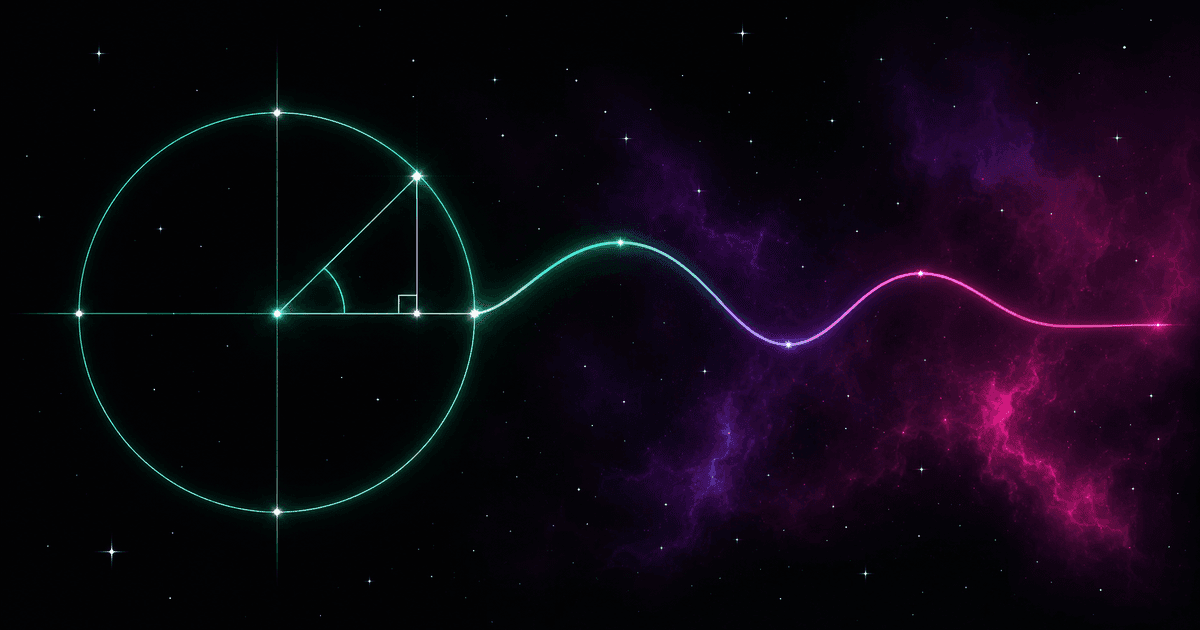
A sine wave is the unit circle unrolled along an axis. See where the period of 2π comes from, why the cosine is a shifted sine, and what happens to the graph of the tangent where the function does not exist.
Before you start
This topic builds on earlier ideas. Before you start, it's worth working through the lessons below — they'll make everything click:
Where this is used
Real situations where you count exactly the way this lesson teaches:
- Mains electricityMains voltage does not sit at 230 V — it runs along a sine, u(t) = 325 · sin(2π · 50 · t). The 230 V figure is the peak divided by √2, so the wires really do carry 325 V at the top of each swing. At 50 Hz one period lasts 0.02 s and the voltage passes through zero 100 times a second, which is the 100 Hz flicker you catch out of the corner of your eye in cheap LED bulbs.
- Daylight hoursIn Warsaw the day runs from 7 h 43 min in December to 16 h 45 min in June: a sine of period one year, centred on 12 h 14 min with an amplitude of 4 h 31 min. The graph also shows where it is steep — near the equinoxes the day grows by close to 4 minutes every 24 hours, in the week of the solstice by a handful of seconds. That is why June evenings seem to stand still.
- Tuning an instrumentConcert A is a vibration at 440 Hz, one period every 1/440 s ≈ 2.3 ms; an octave up halves that period. When a second string sounds 442 Hz, the two waves reinforce and cancel in turn and you hear a beat twice a second — exactly the difference in frequency. The tuner counts those beats and tightens the string until they slow to nothing.
- Machine diagnosticsA fan turning at 1 500 rpm vibrates at 1500/60 = 25 Hz. An analyser breaks the measured vibration into sines and looks at where the peak stands: 25 Hz means an unbalanced rotor, 50 Hz a misaligned coupling. The service team knows what to open up before a bearing seizes.
All formulas
The sine wave
the y-coordinate of the point on the unit circle, as a function of the angle
The cosine wave
the x-coordinate of the same point
Periodicity
the sine and the cosine have period 2π
The cosine as a shifted sine
the same shape, moved by a quarter period
The period of the tangent
π, half as long as the sine’s
Asymptotes of the tangent
there the cosine vanishes and the function does not exist
The sine and the cosine assign a number to every angle, not only to the angles inside a triangle. That makes them functions — and every function can be drawn.
The circle unrolled into a wave
Picture a point travelling around the unit circle. Put the angle on the horizontal axis and the height of the point — its -coordinate — on the vertical one. What you get is the graph of .
The height climbs from (angle ) to (angle ), returns to (angle ), falls to (angle ) and is back at zero after a full turn. Then everything repeats forever — because the point on the circle also starts another lap.
The argument axis is scaled in radians — hence the ticks at , , instead of . If you would rather think in degrees, convert them with our angle converter: is , and is a full turn.
Period, amplitude, range
Three properties are visible on the graph at once.
The period is the length of one complete run, after which the graph repeats. For the sine and the cosine it is , the length of one lap around the circle:
The amplitude is half the distance between the highest and the lowest value — for both functions it is , the radius of the unit circle.
The range is the interval from to . The graph never leaves the horizontal lines and , because a coordinate of a point on a circle of radius cannot be larger.
The cosine is a shifted sine
The two graphs have an identical shape. They differ only in position: the cosine starts at , the sine at zero.
The explanation is on the unit circle: the cosine measures the point's motion horizontally, the sine vertically. It is the same rotation seen from two perpendicular directions, so one run leads the other by . In physics one says the waves are out of phase.
The zeros interleave: the sine vanishes at , the cosine at — exactly where the other one peaks.
The graph of the tangent
The tangent is a quotient, so its graph looks nothing like a wave:
Three differences from the sine wave:
- The period is , not — the graph repeats twice as often: .
- The range is all real numbers — the tangent is bounded neither above nor below.
- The graph has asymptotes — vertical lines the branches approach without ever touching.
The asymptotes stand where the cosine vanishes:
Division by zero is impossible, so does not exist — it is not "a very large number" but the absence of a value. The closer you come to , the larger the tangent grows: , . They rise without bound, yet itself is never reached.
Where these graphs show up
The sine wave is not a school invention — it is the shape almost every repeating phenomenon takes:
- mains voltage — alternating current at varies exactly sinusoidally;
- sound — a pure tone is a sine wave; we hear its frequency as pitch and its amplitude as loudness;
- tides, pendulums, a vibrating spring — all described by the same function;
- a radio signal — the carrier wave is a sine wave with information laid on top of it.
Fourier analysis goes one step further: any periodic signal — even a square digital one — can be written as a sum of sines of different frequencies. Audio and image compression are built on it.
How changing the formula to stretches, squeezes and shifts these graphs belongs to the transformations of functions — they are taught in transforming a graph, in the branch on functions and analysis.
Exercises
The questions check what you read off the graph itself: the value of a function at a special angle — including a negative angle and one past a full turn, which is exactly what periodicity means. Type the exact value, e.g. √2/2. Converting degrees to radians is not asked here — that measure is taught and practised one lesson on, in radian measure.
Practice
Work through a set of exercises — they get harder as you go. At the end you'll see your score and the mistakes worth reviewing.
Common mistakes
- Quoting the period of the tangent as — the tangent repeats every .
- Treating an asymptote as a zero — at the tangent has no value, rather than the value zero.
- Writing — the function has no value there; infinity is not a number.
- An axis scaled in degrees under a formula in radians — if the axis shows , the argument is a radian.
- Swapping the sine and the cosine — the graph that starts at for is the cosine.
- Reading a value outside — for the sine and the cosine no such value exists.
Formula card
Topic: Trigonometric graphs
The sine wave
the y-coordinate of the point on the unit circle, as a function of the angle
The cosine wave
the x-coordinate of the same point
Periodicity
the sine and the cosine have period 2π
The cosine as a shifted sine
the same shape, moved by a quarter period
The period of the tangent
π, half as long as the sine’s
Asymptotes of the tangent
there the cosine vanishes and the function does not exist