
Length is measured in metres, area in square metres. That one exponent looks harmless, and it is responsible for most of the mistakes made in plane geometry. It is why 1 m² does not equal 100 cm², even though 1 m is exactly 100 cm. It is why two plots of land with identical area can need very different amounts of fencing. And it is areas — not side lengths — that the Pythagorean theorem is actually about. This piece is the narrative layer above our geometry branch: where the square came from as the unit of the plane, and what follows from it.
Geometry began with taxes
The name gives the origin away: Greek gē is earth, metrein is to measure. Geometry was first of all land measurement, and for a very concrete reason. The annual flooding of the Nile wiped out field boundaries in the valley, and officials needed them back in order to know what to tax. Greek authors called the Egyptian surveyors harpedonaptai — "rope-stretchers".
This is where care is needed, because the history of geometry usually parts company with the documents at exactly this point. The popular story of a rope with thirteen knots, from which Egyptians supposedly laid out a 3–4–5 triangle to obtain a right angle, is not confirmed by any surviving Egyptian source. It is a nineteenth-century reconstruction, repeated so often since that it has fused with the subject. The rope as a surveying instrument is documented; the use of that particular Pythagorean triple is not.
Far stronger evidence of early skill lies in Mesopotamia. The clay tablet Plimpton 322, dated to around 1800 BCE, probably from Larsa and bought in the 1920s by the publisher George A. Plimpton, holds fifteen rows of numbers. In 1945 Otto Neugebauer and Abraham Sachs recognised them as Pythagorean triples — whole numbers satisfying a² + b² = c². The fourth row carries the triple (12709, 13500, 18541), and the arithmetic checks out to the unit: 12709² + 13500² = 343,768,681 = 18541². Nobody hits a pair like that by accident.
What the tablet was for remains disputed. Eleanor Robson argued that it is a set of school problems built on pairs of reciprocals; Daniel Mansfield and Norman Wildberger, that it is a table of exact, "angle-free" trigonometry. One thing is certain: it was written more than a thousand years before Pythagoras.
Pythagoras himself is a figure we know surprisingly little about. He left not a single piece of writing; everything in circulation about him comes from philosophers writing centuries later, and his community in Croton had the habit of crediting every discovery to its founder. The methodological breakthrough came only with Euclid's Elements (c. 300 BCE, Alexandria): thirteen books in which geometric knowledge was for the first time arranged into a deductive system — primitive notions, axioms, five postulates, and everything else derived by proof. That arrangement set the standard for science for the next two thousand years.
The square as the brick of the plane
Perimeter and area are two different quantities, even though they describe the same figure. Perimeter is a one-dimensional measure — the length of the boundary, counted in metres. Area is two-dimensional: it says how much of the plane the figure takes up.
Why squares, then? Because the plane has two independent, perpendicular directions, and a square of unit side is the simplest figure that fills it along both at once — with no gaps and no overlaps. A rectangle 4 cm by 6 cm can literally be broken into 24 little 1 cm squares laid out in 4 rows of 6. The formula A = a · b is therefore not a convention but a shortcut for counting those tiles. The product of two perpendicular lengths gives a surface — and that is where the notation cm · cm = cm² comes from. Details and exercises are waiting in the lesson on the area of a rectangle.
A triangle is half a rectangle
The formula A = ½ · a · h looks like a separate rule to memorise, and is only a consequence of the previous one. Take any triangle and draw a rotated copy of it: you get a parallelogram with the same base and the same height. The parallelogram just needs straightening — cut a right triangle off one side and slide it to the other, and you have an a × h rectangle. The triangle is exactly half of it.
The same construction explains the condition that gets broken most often: the height must be perpendicular to the base. It is not the slanted side — a leg is always longer than the distance from the vertex to the base, so measuring "along the slope" inflates the result.
Take an isosceles triangle with legs of 13 cm and a base of 10 cm. The perimeter is immediate: 10 + 2 · 13 = 36 cm. The height splits the base in half, so by the Pythagorean theorem 5² + h² = 13², hence h² = 169 − 25 = 144 and h = 12 cm. Only now the area: A = ½ · 10 · 12 = 60 cm². More calculations of this kind are worked out in the lesson on the area and perimeter of a triangle.
Same area, completely different perimeter
Perimeter and area do not move together — and that is what surprises people most. Below are four rectangles with identical area of 36 cm²:
Side a | Side b | Area | Perimeter | What it shows |
|---|---|---|---|---|
| 6 cm | 6 cm | 36 cm² | 24 cm | the square — shortest perimeter of the family |
| 4 cm | 9 cm | 36 cm² | 26 cm | slight stretching, perimeter grows by 8% |
| 3 cm | 12 cm | 36 cm² | 30 cm | perimeter a quarter longer than the square's |
| 1 cm | 36 cm | 36 cm² | 74 cm | extreme flattening — over three times the edge |
The rule is visible at a glance: of all rectangles with a given area, the square has the shortest perimeter, and the more elongated the figure, the more boundary it carries for the same surface. Drop the restriction to rectangles and the winner among all plane figures becomes the circle. This is why "how many square metres is my plot" and "how much fencing do I buy" are two different questions — the first is handled by the area converter, the second by the length converter.
π is not the number 3.14
π is the ratio of a circle's circumference to its diameter, π = C / d. What makes it remarkable is that it comes out identical for every circle, from a ring to an orbit — it is an invariant of Euclidean geometry, not a property of one particular figure.
The history of its approximations is a history of patience. The Egyptian Rhind papyrus corresponds to the value (16/9)² ≈ 3.1605. In the third century BCE Archimedes used the method of exhaustion: he inscribed a regular 96-gon in a circle and circumscribed another around it, and showed that π must lie between them, 3 10/71 < π < 3 1/7, that is between 3.1408 and 3.1429. The upper bound, the fraction 22/7, served for centuries as the engineer's approximation. Only in 1761 did Johann Heinrich Lambert prove that π is irrational — it cannot be written as a ratio of whole numbers. In 1882 Ferdinand von Lindemann showed more: π is transcendental, which finally buried the ancient problem of squaring the circle with compass and straightedge.
The practical conclusion is simple: 3.14 is a rounding, not a value. Consider a path 2 m wide around a circular pool of radius 5 m. The outer radius is 7 m, so the area of the ring is π · 7² − π · 5² = 49π − 25π = 24π m². That is the exact result. Only at the end, if paving has to be ordered, do we turn it into ≈ 75.4 m². Rounding halfway through a calculation accumulates error; rounding at the end does not. The formulas A = πr² and C = 2πr are taken apart in the lesson on the area and circumference of a circle.
Pythagoras is talking about areas
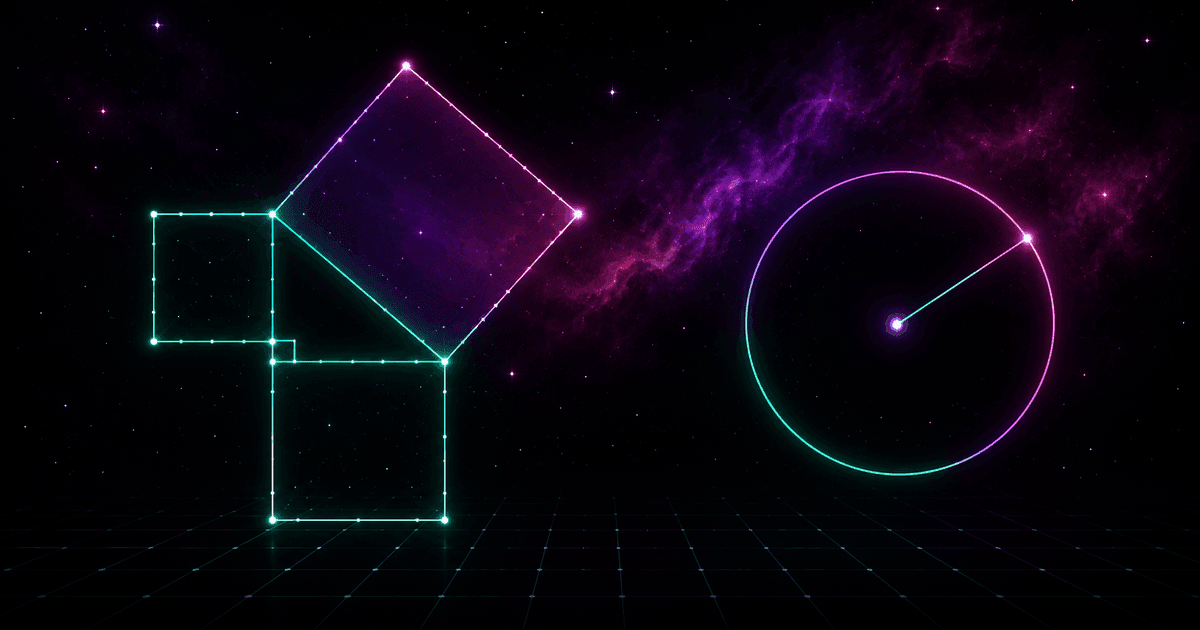
The notation a² + b² = c² is usually read as a rule about sides, but each of those terms is the area of a square built on the corresponding side of a right triangle. The theorem says that the two smaller squares together hold exactly as much surface as the largest one — and that is the content you can see in a drawing.
The simplest proof consists of arranging a square of side a + b in two ways. Once as four congruent right triangles plus a square of side c, and once as the same four triangles plus squares of sides a and b. Since the triangles are identical, what remains must have equal area.
The converse is especially useful in practice: if the sides satisfy the equality, the angle is right. That is the basis of checking a corner on a building site with a 3–4–5 triangle — because 9 + 16 = 25. There is no shortage of other whole-number triples either: (5, 12, 13), (8, 15, 17), (7, 24, 25). One crucial caveat: the equality holds only in a right triangle. No right angle, no theorem — more on which in the lesson on the Pythagorean theorem.
Where the 10,000 in a square metre comes from
Since 1 m = 100 cm, squaring both sides gives 1 m² = (100 cm)² = 10,000 cm². The length factor is squared along with the unit — substitute 100 and you understate the area a hundredfold. The same principle explains land units: an are is a 10 m × 10 m square, that is 100 m², and a hectare is a 100 m × 100 m square, that is 10,000 m². Where morgens, acres and hectares came from is a separate story, told in morgen, acre, hectare.
The rule is most expensive on maps. A linear scale of 1:k means an areal scale of 1:k². A plot measuring 2 cm × 4 cm on a 1:5000 map covers 8 cm² of paper, but on the ground 8 · 5000² = 200,000,000 cm², that is 20,000 m², that is 2 ha. Multiply the area by 5000 instead of by 25,000,000 and you are off by a factor of five thousand.
The six most expensive mistakes
| Mistake | Where it comes from | How it actually works |
|---|---|---|
| Confusing area with perimeter | no distinction between a 1D and a 2D measure | perimeter is boundary length, area is content |
| Height measured along the slanted side | mistaking a leg for the height | the height meets the base at a right angle |
| Substituting the diameter for the radius | r and d swapped in the formula | d = 2r, and the area is πr², not πd² |
Treating 3.14 as an exact π | habit from school arithmetic | π is irrational; keep exact results in terms of π |
| Pythagoras without a right angle | ignoring the theorem's assumption | a² + b² = c² holds only in a right triangle |
| Converting area linearly | carrying the length factor over unchanged | the conversion factor gets squared |
What is convention and what is truth
Finally, the division that puts this whole branch in order. Part of plane geometry is human convention, and part is a hard consequence of what a plane is.
| Element | Nature | Why |
|---|---|---|
| Units (m, cm, ha) | convention | the choice of a length standard is a civilisational decision, today the SI |
| Dividing a full turn into 360° | convention | a Babylonian inheritance; 360 has 24 divisors, so it splits without fractions |
The constancy of C / d = π | truth | an invariant of every circle in the plane |
A = ½ · a · h | truth | follows from cutting a triangle out of half a rectangle |
a² + b² = c² | truth | a consequence of Euclid's axioms at zero curvature |
| Triangle angles sum to 180° | truth in the plane | equivalent to the fifth postulate; on a sphere the sum is larger |
That last entry is the most instructive. The 180° sum is not a truth about triangles in general, only about plane ones — on a globe, a triangle with one vertex at the pole and two on the equator has three right angles, that is 270°. Why we divided a full turn into 360 parts in particular is the subject of our piece on 360 degrees; the kinds of angles and the proof of the 180° sum are in the lesson on angles.
The unit square, then, is more than a school tile. It is the way the plane becomes countable — and as long as that stays in view, the rest of plane geometry stops being a list of formulas to memorise and becomes a handful of consequences of a single decision.
Further reading
- Euclid, Elements — available in annotated translations; the source of the entire axiomatic arrangement.
- Eleanor Robson, Words and Pictures: New Light on Plimpton 322, American Mathematical Monthly 109 (2002) — the most cautious reading of the tablet.
- Daniel Mansfield, Norman Wildberger, Plimpton 322 is Babylonian exact sexagesimal trigonometry, Historia Mathematica 44 (2017) — the competing thesis.
- Cuneiform Digital Library Initiative (cdli.earth) — a digital archive of cuneiform tablets, Plimpton 322 among them.
- MacTutor History of Mathematics Archive, University of St Andrews — entries on Babylonian mathematics, Archimedes and Lambert.
- Delta (deltami.edu.pl) — accessible articles on Euclid's fifth postulate and on methods of computing areas.