
In A New Hope, Han Solo brags that his Millennium Falcon made the Kessel Run "in less than twelve parsecs." It sounds impressive — until you remember that a parsec is a unit of distance, not time. It is like boasting that you ran a marathon in under two kilometers. We make the very same slip, quietly, almost every day with the light-year. The word "year" in its name tricks us into thinking about time — yet it is still a measure of distance.
A light-year measures a road, not a clock
A light-year is the distance light travels through a vacuum in one year. With the speed of light fixed at c = 299,792,458 m/s and a Julian year of exactly 365.25 days (that is 31,557,600 seconds), the result is a round — if gigantic — number:
1 light-year = 299,792,458 m/s × 31,557,600 s = 9,460,730,472,580,800 m
That is about 9.46 trillion kilometers. This is why a sentence like "that galaxy is five million light-years in the past" is doubly misleading: a light-year describes neither past nor future. Correctly: light from a galaxy 100 million light-years away travelled to us for 100 million years — the distance is in light-years, the travel time is in years. Space and time are two different axes, and you may not mix them, however much the name tempts you.
A language note: the correct English spelling is light-year, with a hyphen; lightyear (one word) is an error, and light year (two words) is acceptable only informally. English and Polish alike are riddled with twin traps: the "dark side of the Moon" is not dark at all (it receives just as much sunlight as the near side — it is simply the far side, unseen from Earth), a "meteor" is a streak of light in the atmosphere, while a "meteorite" is the rock that survives and hits the ground. Precise names are not pedantry — they are the foundation everything else rests on.
Where the idea came from
The light-year was born in pain and resistance. In 1838 Friedrich Bessel was the first to measure the distance to a star — 61 Cygni — and worked out that light needed about 10.3 years to cross it. And yet he consistently avoided the unit "light-year." His reasoning was sound: in the first half of the 19th century the speed of light was not yet an accepted, fixed constant — its estimates kept shifting after the experiments of Fizeau (1849) and Foucault (1862). Bessel had no wish to tie his painstaking parallax measurements to a variable parameter.
The term "light-year" (Lichtjahr) was popularized only in 1851 by the German astronomy writer Otto Ule, who compared it to "an hour's walk." Professional astronomers long turned up their noses — Arthur Eddington called the light-year an "inconvenient and unnecessary" unit and argued it should give way to the parsec. And it is the parsec, not the light-year, that is the working unit of professional astronomy today.
The parsec — a unit straight from the measurement
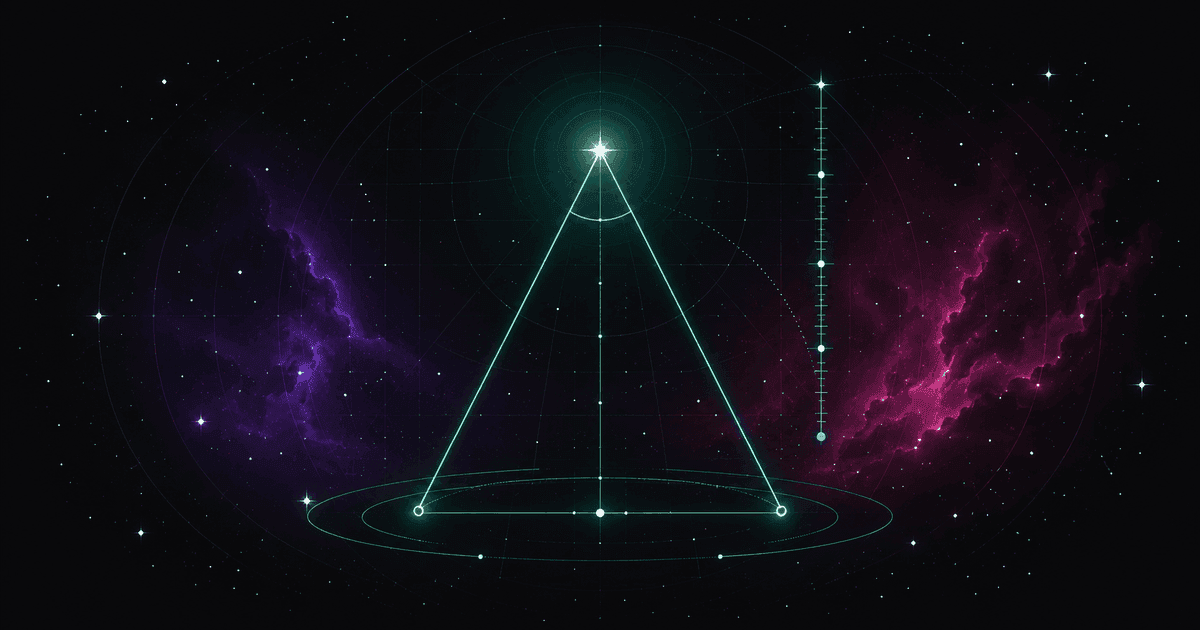
The parsec (pc) is the distance from which the semi-major axis of Earth's orbit (one astronomical unit) subtends an angle of one arcsecond — that is, 1/3600 of a degree. The name is short for "the parallax of one arcsecond." Astronomers love it because it drops straight out of the raw measurement: they measure how far a star "wobbles" against the sky over a year (its parallax p in arcseconds), and the distance in parsecs is simply its reciprocal, d = 1/p.
The geometry is simple. For tiny angles tan(θ) ≈ θ in radians, and one radian is about 206,265 arcseconds. Hence:
1 parsec ≈ 206,265 AU ≈ 3.086 × 10¹⁶ m ≈ 3.2616 light-years
For our nearest neighbour — Alpha Centauri — the best measured parallax is about 750.8 milliarcseconds, giving a distance of roughly 1.33 parsecs, or 4.34 light-years. Note the order: the astronomer starts with an angle and computes the distance from it. The light-year is only the "translation" of that number into everyday language.
Three rungs of one ladder
Kilometers are useless in space — writing interplanetary distances with a dozen digits only invites calculation errors. So the International Astronomical Union (IAU) sanctioned a hierarchy of units matched to scale. Here they are, with the exact values from the data behind our astronomical distance converter:
| Unit | Symbol | Value (exact / approximate) | What it is for |
|---|---|---|---|
| Astronomical unit | AU | 149,597,870,700 m (exact) | distances within the Solar System |
| Light-year | ly | 9,460,730,472,580,800 m | distances to stars (popular use) |
| Parsec | pc | ≈ 3.0857 × 10¹⁶ m ≈ 3.2616 ly | professional astrometry |
The astronomical unit reflects the mean distance from Earth to the Sun. The first attempts to measure it were by Giovanni Cassini (parallax of Mars, 1672) and Ole Rømer (analysing eclipses of Jupiter's moons, 1676). For centuries its value was entangled with the dynamics of the Solar System, until in 2012 the IAU's resolution B2 cut it loose from the Sun's mass and pinned it firmly to the meter: 1 AU = 149,597,870,700 m, exactly. Light crosses that distance in about 499 seconds — roughly 8.3 minutes. When you look at the Sun, you see it as it was more than eight minutes ago.
Why our brains stumble
The problem is not the mathematics but the biology. The human mind evolved to gauge distances in meters and kilometers, and time in cycles of day and season — because that was enough to survive. Nobody needed an intuition for trillions of kilometers. So extreme quantities hit a wall that science calls anumeracy.
You can see it even in languages. The Pirahã and Mundurukú peoples of the Amazon basin have no precise words for numbers greater than three — they get by with "a few" and "many." Handling large numbers precisely is therefore not innate; it is a cultural invention that requires external props — from tally marks on the Ishango bone to today's calculators. Neuroscientists add that we "see" small sets (up to four items) instantly with the right hemisphere, while large, abstract numbers demand the left hemisphere and a laborious mapping onto an inner "number line." A light-year cannot be felt — it can only be computed.
There is a certain poetic symmetry in this. An analysis by the astrophysicist Franco Vazza and the neurosurgeon Alberto Feletti found a striking topological resemblance between the network of neurons in the brain (tens of billions of cells) and the cosmic web of galaxies (at least a hundred billion). In both systems, active matter makes up only about 25–30% of the mass, while the rest is "scaffolding" — water in the brain, dark matter and dark energy in the cosmos. The instrument with which we try to grasp the universe is surprisingly like the universe itself.
How to picture it: the grapefruit model
Since intuition fails, astronomers reach for scale models. Shrink the whole Solar System by a factor of 10 billion (a scale of 1:10¹⁰). The Sun contracts to the size of a grapefruit, and the rest becomes a walk through town:
| Object | Size in the model | Distance from the "grapefruit Sun" |
|---|---|---|
| Sun | sphere ⌀ ≈ 14 cm (a grapefruit) | — |
| Earth | grain of sand ⌀ ≈ 1.3 mm | ≈ 15 m |
| Jupiter | marble ⌀ ≈ 14 mm | ≈ 78 m |
| Neptune | pea ⌀ ≈ 4.9 mm | ≈ 450 m |
| Proxima Centauri | another grapefruit | ≈ 4,000 km |
Look at the last row. At this scale the entire Solar System fits within a few hundred meters — and the nearest star is a second grapefruit four thousand kilometers away, as if across an ocean. Between them: almost nothing. Isaac Asimov captured that emptiness vividly — if all the matter in the universe were spread out evenly, a single grain of sand would sit in the middle of an empty room 30 km on a side.
Voyager 1 and the one-light-day threshold
Nothing illustrates these distances better than humanity's most distant envoy. The Voyager 1 probe, launched in 1977, is now racing through interstellar space at about 61,000 km/h (17 km/s). According to NASA's ephemerides, on 18 November 2026 it will cross the symbolic threshold of one light-day from Earth — the distance light travels in 24 hours, about 173 AU (26 billion km). It will be the first human-built object to reach that far.
At this range a radio signal — travelling at the speed of light — needs a full day one way; sending a command and receiving confirmation takes 48 hours. The probe is fading: its radioisotope generator now delivers roughly half its original power, so engineers are switching instruments off one by one. And yet the grand tally is humbling — the table below shows how long a journey to the nearest targets would take by various means:
| Target | Distance | Car (140 km/h) | Jet (900 km/h) | Voyager 1 (≈61,000 km/h) |
|---|---|---|---|---|
| Moon | 384,400 km | ≈ 114 days | ≈ 18 days | ≈ 6.3 hours |
| Sun | ≈ 149.6 million km | ≈ 122 years | ≈ 19 years | ≈ 102 days |
| Proxima Centauri | 4.24 ly (≈ 40 trillion km) | ≈ 33 million yrs | ≈ 5 million yrs | ≈ 75,000 years |
Despite nearly half a century of flight, Voyager has covered only about 0.06% of the way to the nearest star system — roughly one part in sixteen hundred. To cross a single light-year at its current pace it would need another 18,000 years or so. Only in about 40,000 years will it pass within about 1.6 light-years of the star Gliese 445. The cosmos is not distant — it is unimaginably distant, and that is a difference in kind.
Measurement as a tool for thought
The astronomical unit, the light-year and the parsec are not dry abbreviations. They are cognitive prostheses — the way a mind built for the savanna sidesteps its own limits and grasps a reality it cannot feel. Their history, from Bessel's cautious estimates to the IAU's rigid resolution, is a story of the patient elimination of ambiguity.
That is why insisting "a light-year is distance, not time" is not nitpicking. It is the precondition for reading telescope data correctly at all, and for planning missions. Physically we are still stuck at the scale of meters. But with three well-defined units we can describe, with full precision, something no eye will ever take in.
Further reading
- International Astronomical Union, resolution B2 (2012) — the official, rigid definition of the astronomical unit.
- The Light-year, Parsec and Astronomical unit entries on Wikipedia — solid overviews with history and conversion factors.
- F. Vazza, A. Feletti, The Quantitative Comparison Between the Neuronal Network and the Cosmic Web (Frontiers in Physics, 2020) — the analysis of the brain–galaxy-web resemblance.
- NASA / Jet Propulsion Laboratory, Voyager Mission Status — current flight parameters and the one-light-day milestone (18 Nov 2026).