
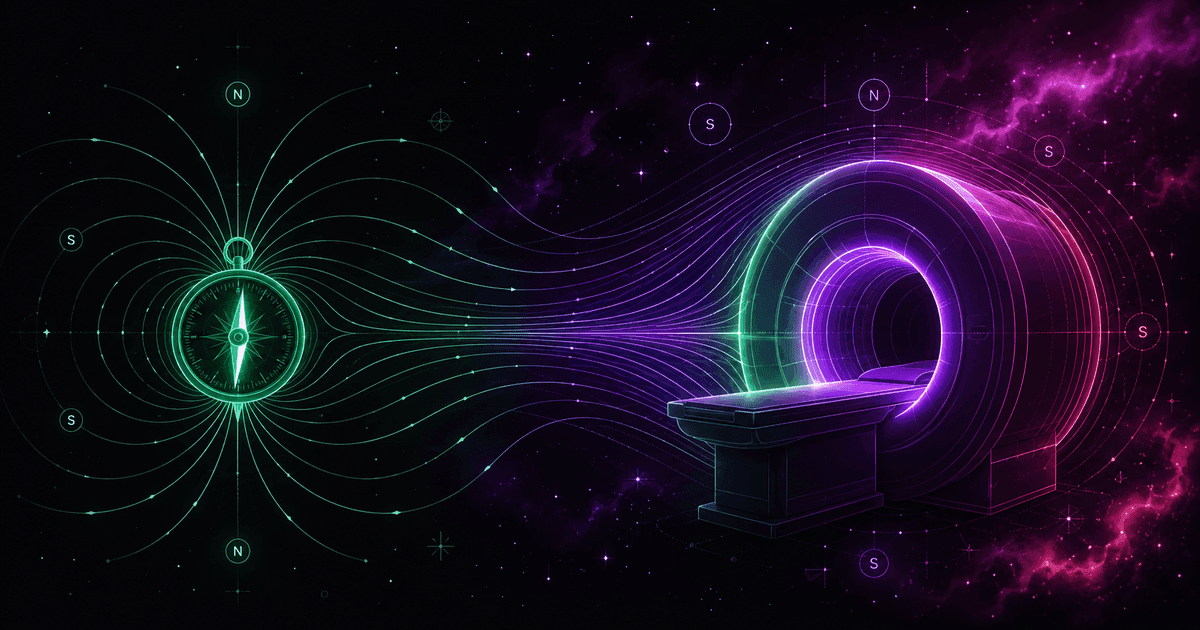
A metal compass needle, balanced on a thin pivot, quivers for a moment and then, with unshakeable consistency, points north. That simple observation let humanity sail safely across vast oceans for centuries. And yet the force that steers the needle is surprisingly — even paradoxically — weak. The Earth's magnetic field at the planet's surface is hundreds of times weaker than the field of the cheap ferrite magnet you use to pin notes to the fridge. To understand this paradox, we have to enter the world of magnetic flux density — the quantity describing how densely the invisible field lines pierce space.
Anatomy of the quantity: tesla, gauss, and what "flux density" means
A magnetic field is described by several related quantities that are easy to confuse. The most important is magnetic flux density, written as the vector B and also called simply magnetic induction. The name captures its meaning: it tells you how many field lines pass through a unit of area perpendicular to those lines. It is B that represents the real strength of the field inside bodies and media — and it is what every instrument measures, from a compass to a scanner.
It helps to distinguish B from two related ideas. Magnetic field strength H (SI: amperes per meter, A/m) describes the field produced by flowing current alone, without the response of the material it propagates through. Magnetic flux Φ (in webers, Wb) is the total "amount" of field passing through a given surface — the integral of the flux density over that surface. In a vacuum the relation is simple: B = μ₀H, where μ₀ is the magnetic permeability of vacuum.
The official SI unit of flux density is the tesla (T), adopted in 1960 at the 11th General Conference on Weights and Measures on the proposal of the Slovenian engineer France Avčin. It is named after Nikola Tesla, the creator of alternating-current systems. The definition follows straight from the Lorentz force — F = q(v × B): one tesla is the field that exerts a force of one newton on a charge of one coulomb moving perpendicular to the field lines at 1 m/s.
The older unit comes from the CGS system: the gauss (G), named in 1936 after Carl Friedrich Gauss, one of the first to study terrestrial magnetism. Although standards bodies now discourage it, the gauss still reigns in geophysics, astrophysics, and permanent-magnet catalogs. The conversion is round and beyond dispute:
1 T = 10,000 G
From there the whole scale falls into place: 1 mT = 10 G, and 1 µT = 0.01 G = 10 mG. The very same multipliers drive the magnetic flux density converter on this site. As an aside: the SI redefinition of 20 May 2019 subtly changed the tesla's status — μ₀, previously fixed at exactly 4π × 10⁻⁷ H/m, became an experimentally measured quantity carrying a small uncertainty.
The paradox of terrestrial magnetism: a weakness that rules the globe
The Earth's magnetic field is born of convective motions of liquid iron and nickel in the planet's outer core (the geodynamo). It is a shield protecting the biosphere from the solar wind and cosmic radiation — and yet, despite that role, its flux density at the surface is tiny: from 25 to 65 µT (0.25–0.65 G), depending on latitude. About 31 µT at the equator, around 50 µT in Poland, up to 65 µT near the magnetic poles. The weakest region, the South Atlantic Anomaly between Africa and South America, drops to about 22 µT; data from ESA's Swarm satellites and the World Magnetic Model WMM2025 show the anomaly deepening and drifting west by about 20 km a year — a real problem for the electronics of satellites in low orbits.
Meanwhile an ordinary fridge magnet delivers about 5 mT (50 G) at its surface — roughly a hundred times stronger than the field of the entire planet. So why does a compass needle respond faithfully to the Earth's weak field while ignoring much stronger magnets nearby? Two principles are responsible:
- No competition, minimal friction. The needle is precisely balanced on a pivot or floats in a low-viscosity fluid, and there is usually no other field source close by. Even the microscopic torque (τ = μ × B) that the 50 µT field exerts on the needle's magnetic moment is enough to overcome the resistance and align it with the field lines.
- Uniformity versus gradient. The field of a small permanent magnet falls off sharply with distance — proportional to the cube of the distance (B ∝ 1/r³). Move the magnet a dozen centimeters away and its field drops below the threshold of detection. The Earth's field is weak, but on the scale of a room or a city it is perfectly uniform: the whole needle experiences the same vector, which produces a clean torque with no translating force — and a stable reading.
History offers an anecdote to match: in the 1830s Gauss, wanting to eliminate interference from iron nails and pipes, built a magnetic observatory in Göttingen made entirely of wood, so he could measure the absolute strength of the Earth's field precisely.
The scale of magnetic power: from thought to black holes
Magnetic fields in the universe and those made by humans span more than 30 orders of magnitude. The table below shows where the quiver of a compass sits against that backdrop.
| Object or phenomenon | Typical flux density B | In gauss (G) | Notes |
|---|---|---|---|
| Human brain activity | 10 fT – 1 pT | 10⁻¹⁰ – 10⁻⁸ | Detected by magnetoencephalography (MEG) |
| Human heart field | 0.1 – 1 nT | 10⁻⁶ – 10⁻⁵ | Strongest biomagnetic signal in the body |
| Earth's surface | 25 – 65 µT | 0.25 – 0.65 | Varies with latitude and the SAA |
| Fridge magnet | ~5 mT | ~50 | Ferrite or flexible material |
| Sunspots | 0.1 – 0.4 T | 1,000 – 4,000 | Regions of concentrated field lines on the Sun |
| Neodymium magnet (NdFeB) | 0.1 – 0.5 T | 1,000 – 5,000 | Remanence Bᵣ reaches 1.4 T |
| MRI scanner (clinical) | 1.5 – 3 T | 15,000 – 30,000 | Superconducting magnets |
| Whole-body MRI Iseult | 11.75 T | 117,500 | CEA Paris-Saclay, brain imaging |
| Record steady (DC) magnet | 45.22 T | 452,200 | Hybrid magnet, SHMFF in Hefei |
| Strongest non-destructive pulse | 100.75 T | ~1,000,000 | Pulse ~15 ms, Los Alamos |
| Destructive pulse (flux compression) | up to 1,200 T | 12,000,000 | Lasts microseconds, the coil is destroyed |
| Neutron stars and magnetars | 10⁸ – 10¹¹ T | 10¹² – 10¹⁵ | Strongest natural fields in the universe |
One of the most spectacular demonstrations of a mid-range field is diamagnetic levitation. In 2000 Andre Geim and Michael Berry won an Ig Nobel Prize for floating a live frog in the air inside an electromagnet of 16 T. Water, the main component of living organisms, is a weak diamagnet: in such a powerful, non-uniform field an opposing magnetic moment is induced in it, and the repelling force exactly balances gravity.
Medical dominance: the physics of magnetic resonance
The leap from the Earth's microtesla field to a hospital scanner perfectly illustrates the technological reach. Clinical MRI machines run at 1.5 T or 3 T — a 3 T field is about 60,000 times stronger than the Earth's natural field. Such flux density in a bore wide enough for a patient (60–70 cm) cannot be achieved with an ordinary copper electromagnet: the resistance of copper would melt the coils with Joule heating. The rescue is superconductivity — coils of a niobium-titanium alloy (NbTi), cooled with liquid helium below 4.2 K, lose their resistance entirely. Once injected, the current circulates in them endlessly, giving a stable field with no power draw.
The imaging principle rests on the interaction of this static field (B₀) with hydrogen nuclei — single protons, abundant in the water that makes up most of the body's mass. Protons have spin and behave like microscopic magnets; in a strong field they partially align along B₀. A short pulse of radio waves at the Larmor frequency (ω₀ = γB₀) knocks them out of equilibrium. That frequency depends directly on the flux density: for 3 T it is about 128 MHz. When the pulse ends, the protons relax back, emitting a signal picked up by the coils — and because different tissues have different relaxation times (T₁, T₂), an image of excellent contrast emerges. The same physics drives functional MRI (fMRI), which uses the BOLD effect to map brain activity: oxygenated and deoxygenated hemoglobin differ in their magnetic properties, so a rush of blood to a working region locally changes the signal.
The most powerful whole-body MRI scanner is Iseult at the NeuroSpin facility (CEA Paris-Saclay), generating a full 11.75 T. The structure weighs 132 tons and took almost two decades to build. The challenges are extreme: enormous Maxwell stresses try to tear the windings apart (risking a sudden loss of superconductivity, a "quench"); the gradient coils vibrate in the strong field, generating noise above 130 dB; and at 11.75 T the Larmor frequency reaches 500 MHz, so the radio wave is only a few centimeters long inside tissue and creates interference "dark spots" that advanced algorithms must correct.
The limits of human ability: records and pulsed destruction
Beyond medicine, scientists race for ever higher fields for solid-state physics and fusion research. The official record for a steady (DC) field in a large-bore magnet is 45.22 T, set on 12 August 2022 at the SHMFF facility in Hefei, China — a fraction of a tesla better than the 45 T record that had belonged to the American MagLab in Florida since 1999. These are hybrid magnets: an outer superconducting magnet plus an inner copper resistive magnet (of the Bitter type), through which currents flow that demand power on the order of 30 MW and cooling with thousands of liters of ice-cold water per minute.
In parallel, high-temperature superconductors such as REBCO are advancing. In 2019 Seungyong Hahn's team at MagLab tested a coil called the "Little Big Coil," about the size of a roll of paper and weighing 390 grams, which reached 45.5 T inside a strong background field (48.7 T in a later version). The trick was to drop the insulation between turns of the tape: during a local quench the current can flow radially through the metal, bypassing the endangered zone and protecting the magnet from melting.
The 100 T barrier is beyond steady magnets — it needs pulsed designs. At the Pulsed Field Facility in Los Alamos, a non-destructive magnet safely delivers 100.75 T for just 15 milliseconds, powered by a 1.4 GW generator and a bank of capacitors, immersed in liquid nitrogen. Above that limit, Maxwell forces destroy any known material, so single-use destructive magnets (flux compression) are used. At the University of Tokyo in 2018 this method produced a full 1,200 T — the pulse lasted 100 microseconds and the coil was violently destroyed. And even that pales beside magnetars, whose fields on the order of 10⁸–10¹¹ T deform the very structure of matter.
Three myths under scrutiny
"The Earth's magnetic field is strong." The intuition comes from the field wrapping the whole planet and reaching far into space. But its flux density at the surface is just 25–65 µT (0.25–0.65 G) — a hundred times less than an ordinary fridge magnet. The secret of the magnetosphere lies in its colossal volume and reach, not in local strength.
"Magnetic healing bracelets improve health." This is the foundation of a multi-billion-dollar industry, and it is physically baseless. The iron in hemoglobin is not ferromagnetic; blood is a weak dia- or paramagnet of negligible susceptibility. If magnets really affected blood the way the ads claim, the 3 T field in a scanner (tens of thousands of times stronger than a bracelet) would stop a patient's circulation — which never happens. A rigorous meta-analysis by Pittler and colleagues (CMAJ 2007) found no effect beyond placebo. Clinical pulsed-field therapy (PEMF), based on inducing currents in tissue, is a different matter — it has proven, if modest, effects.
"Tesla and gauss are exactly the same, so fully interchangeable." The numerical relation is simple (1 T = 10⁴ G), but these are units of two different systems — SI and the historical CGS — whose equations differ in structure (for instance, μ₀ is absent from some CGS formulas). On top of that, magnet catalogs routinely confuse flux density B (teslas, gauss) with field strength H (A/m, oersteds): coercivity, the resistance to demagnetization, is a property of H but is often wrongly quoted in gauss.
The takeaway: "strong field" is relative
The notion of a "strong magnetic field" is inherently relative. For a freely suspended compass needle, the meager 50 µT of the Earth's field is the dominant force that has set the direction of human travel for millennia. Modern medicine works at a dozen or more teslas, peering non-invasively into the human brain. And at the far end of the scale wait pulsed laboratories and cosmic magnetars with fields on the order of billions of teslas, where matter loses its familiar structure. Understanding magnetic flux density as a density of flux lets us see how those invisible lines organize the universe — from a compass needle to the heart of a dying star.
Further reading
- David Halliday, Robert Resnick, Jearl Walker, Fundamentals of Physics, Vol. 3, Wiley — the classic textbook covering the magnetic field, the Lorentz force, and electromagnetic induction in detail.
- Max H. Pittler, Elaine M. Brown, Edzard Ernst, Static magnets for reducing pain: systematic review and meta-analysis of randomized trials, "CMAJ" 2007, vol. 177, no. 7, pp. 736–742 — the meta-analysis debunking the effectiveness of static healing magnets.
- Arnaud Chulliat et al., The US/UK World Magnetic Model for 2025–2030: Technical Report, NOAA/NCEI 2025 — the official report with current data on the geomagnetic field.
- Lionel Quettier et al., Commissioning Completion of the Iseult Whole Body 11.7 T MRI System, "IEEE Transactions on Applied Superconductivity" 2020, vol. 30, no. 4 — the engineering of the world's strongest MRI scanner.