
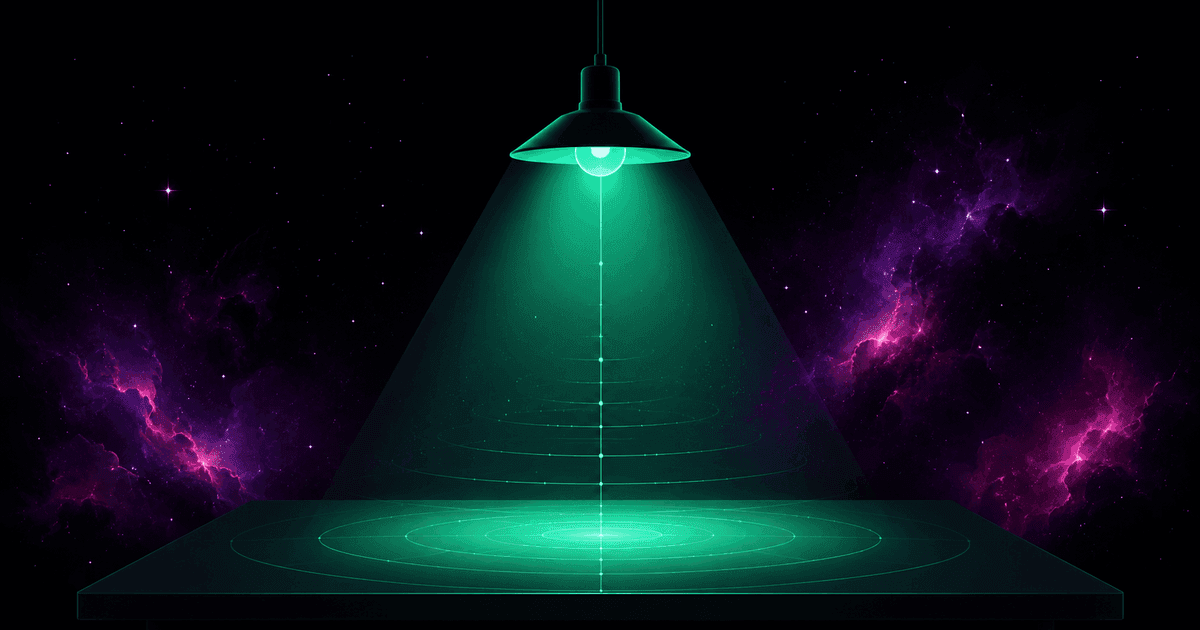
You walk into the lighting aisle of a hardware store and face rows of shelves buckling under LED bulbs. The boxes shout numbers: “800 lumens,” “1000 lumens,” “1600 lumens.” Intuition offers a simple rule — the bigger the number, the brighter the room. Yet this is one of the most common cognitive traps in everyday technology. A lumen tells you only how much light a source emits in total, in every direction. It says nothing about how much of that light actually reaches your desk, the floor, or the page of the book you are reading. That is the job of an entirely different quantity — illuminance, whose SI unit is the lux.
The chain of light: from candela to lux
Photometry — the science of measuring light the way the human eye sees it — arranges its units in a logical chain. It is worth tracing, because only then can you see where the lumen ends and the lux begins.
At the base stands the candela (cd), one of the seven SI base units. It describes luminous intensity — how strongly a source shines in a particular direction. By the definition of the International Bureau of Weights and Measures (BIPM), the candela is set so that monochromatic radiation at a frequency of 540×10¹² Hz — the yellow-green light near 555 nm to which the eye is most sensitive in daylight — has a luminous efficacy of exactly 683 lumens per watt. In practice: a source emitting 1/683 of a watt of that green light per steradian in a given direction has a luminous intensity of one candela.
The next link is the lumen (lm) — luminous flux, the total “amount” of light flowing out of a source in all directions. It comes from multiplying luminous intensity by solid angle:
Φ = I · Ω
where Φ is flux (lm), I is intensity (cd), and Ω is the solid angle in steradians (sr). Since a full sphere around a source spans 4π ≈ 12.57 sr, an isotropic source of one candela emits about 12.57 lumens in total. Picture a sphere one metre in radius with a point source at its centre: through a one-square-metre window cut into that sphere passes exactly one lumen.
The final link is the lux (lx) — illuminance, the density of flux falling on a surface. The definition is disarmingly simple: one lux is one lumen spread over one square metre.
1 lx = 1 lm / 1 m²
And here the whole cycle closes: from a source’s directional strength (candela), through the total light emitted (lumen), to the density of light reaching a target (lux). It is the lux — not the lumen — that a photographer’s light meter and your phone’s brightness sensor measure, because it answers the question “how much light is here, on this surface.”
The mathematics of distance: the inverse-square law
The same bulb can produce wildly different impressions of brightness depending on how far away it hangs. If a reflector concentrates 1000 lumens onto one square metre, that surface receives 1000 lux. If those same 1000 lumens spill evenly across a 10 m² room, only 100 lux remain. Light disperses, and its density drops ever faster the farther you are from the source.
This is governed by one of the most fundamental laws in optics — the inverse-square law. For a point source, illuminance falls in proportion to the square of the distance:
E = I / d²
where E is illuminance (lx), I is luminous intensity (cd), and d is the distance from the source (m). The key word is “square”: doubling the distance does not halve the brightness — it quarters it. Take a lamp of 100 candela above a desk:
| Lamp-to-desk distance | Calculation | Illuminance on desk |
|---|---|---|
| 1 m | 100 / 1² | 100 lx |
| 2 m | 100 / 2² = 100/4 | 25 lx |
| 3 m | 100 / 3² = 100/9 | ≈ 11.1 lx |
Raising the lamp from 1 to 3 metres robs the desk of nine-tenths of its light. That is why lighting designers calculate mounting heights so carefully — the lumen figure on the box, without distance and beam geometry, is an incomplete parameter. But the same rule has a friendly, practical side: if a desk lamp is too dim, just move it closer. Halving the distance gives four times the illuminance — with no new bulb.
Foot-candles, phots and the imperial tradition
Although SI dominates science, other units of illuminance still turn up in practice. In the United States the foot-candle (fc) reigns — one lumen per square foot. Since a square foot is about 0.0929 m², the conversion is fixed:
1 fc ≈ 10.764 lx
Engineers often shorten this to “one foot-candle is roughly 10 lux.” The unit lives on in American building codes and in cinematography, where traditional film light meters are calibrated in foot-candles.
Historical, by contrast, is the phot (ph) from the old CGS system — one lumen per square centimetre. Because a square metre holds 10,000 cm², one phot equals a whopping 10,000 lux. To describe very strong light (sunlight, say), the kilolux (klx) — simply 1000 lux — is handier. You will find all of these in the illuminance converter.
The scale of illuminance: from a moonless night to the noon sun
The human eye works across more than ten orders of magnitude — from deep night to blinding noon. The scale below shows where typical situations fall on that spectrum (these are orders of magnitude, strongly dependent on weather and season):
| Environment / situation | Illuminance |
|---|---|
| Moonless, overcast night | ≈ 0.0001 lx |
| Moonless night, clear sky | ≈ 0.002 lx |
| Full moon on a clear night | 0.05–0.3 lx (typ. 0.25) |
| Civil twilight (sun 6° below the horizon) | ≈ 3.4 lx |
| Home living room in the evening | ≈ 50 lx |
| Corridors, circulation routes | 80–150 lx |
| Sunrise / sunset | 300–400 lx |
| Office work plane (standard) | 320–500 lx |
| Precise visual tasks | 750–1000 lx |
| Overcast day | 1000–2000 lx |
| Shade on a clear day | 10,000–25,000 lx |
| Direct sunlight | 32,000–100,000 lx |
The difference between a dark night and a sunny noon is about a hundred million times. And here a fascinating puzzle arises: if a full moon gives barely a quarter of a lux — roughly 1/400,000 of summer sunshine — how is it that under a full moon we walk about fairly freely and make out the shapes around us?
A quarter of a lux, yet you can see — the eye’s adaptation trick
The answer lies in the biochemistry of the retina. It holds two kinds of photoreceptor: cones (colour and detail vision in good light — photopic vision) and rods (monochromatic, but astonishingly sensitive — scotopic, night vision). There are about 120 million rods and only 6–7 million cones. It is the rods that rescue us after dark.
Moving from light to darkness triggers dark adaptation, lasting 30–45 minutes. Its core is the slow regeneration of rhodopsin — the light-sensitive pigment in rods, which bleaches almost instantly in bright light. For the first few minutes in the dark, the cones quickly reach their modest peak sensitivity; around minute 5–10 comes the so-called rod-cone break, and the rods take over vision. As adaptation proceeds, the eye’s sensitivity peak also shifts — from 555 nm (yellow-green) toward 507 nm (blue-green). This is the Purkinje shift.
It has a practical consequence. Rods are nearly blind to deep red (above ~650 nm), which is why pilots, astronomers and submarine crews use red instrument lighting: the cones read the dials while the rods stay in undisturbed adaptation, ready to watch the darkness beyond the window or periscope.
Three lighting myths
A few oversimplifications have grown up around light — and they lead to poor buying and design decisions.
Myth one: “more lumens = a brighter room.” As we now know, perceived brightness is decided by the lux, not the lumen. A 2000-lumen bulb guarantees nothing if the walls are painted a dark, matte, highly absorbing colour — most of the light is then lost for good. In professional lighting engineering, average illuminance is computed not from raw flux but with reflectance factors for walls and ceiling, luminaire efficiency, and a maintenance factor (ageing and dirt on fittings). Judging brightness by the lumen figure alone is therefore meaningless.
Myth two: “lux and luminance are the same thing.” This is one of the most frequent errors. Lux describes light falling onto a surface — entirely independent of its colour or texture. Luminance (cd/m², colloquially “nits”) describes light reflected or emitted by a surface toward the eye. Picture a white sheet of paper and a black card lying side by side: the illuminance on both is identical, say 500 lux. But the white sheet reflects ~80% of the light and the black card a few percent — so their luminances are wildly different, and the eye instantly sees one as bright and the other as dark. That is why screens are specified in nits, not lux — more on this in “Nits, candelas and the mysterious π”.
Myth three: “the more light in an office, the better.” Excess light does harm. First — glare: discomfort glare (irritation, fatigue, headaches) and disability glare (real loss of vision). Standard EN 12464-1 requires a unified glare rating of UGR ≤ 19 for typical offices; overpowered fittings without diffusers, shining straight into a glossy monitor, cause asthenopia — eye strain. Second — the circadian rhythm. The retina holds light-sensitive ganglion cells (ipRGCs) carrying the pigment melanopsin, which form no image but govern the secretion of melatonin and cortisol. Strong, “cool” light in the morning is stimulating (rightly so — the CIE S 026 standard recommends about 250 melanopic lux EDI at the eye), but the same light kept up in the evening disrupts sleep. A good office is a golden mean, not a mindless multiplication of lux.
Why a desk needs exactly 500 lux
The European standard EN 12464-1 requires exactly 500 lux on the office work plane (desktop height, about 0.75 m). The figure is no accident — it comes from years of research into visual performance and comfort. This level lets you read print, write by hand and work long hours at a monitor while keeping high contrast and reducing the accommodative effort of the eye. Research coordinated by the International Commission on Illumination suggests that lighting below the standard can lower productivity and noticeably increase error rates.
Crucially, the standard does not fixate on the lux number alone. It puts great weight on uniformity (the ratio of minimum to average illuminance), which in the task area should not fall below 0.6 — otherwise deep shadows and sharp transitions form, tiring the pupil at every shift of gaze. It also defines a gentle brightness gradient: with a task at 500 lux, the immediate surround should be at least 300 lux and the wider background at least 100. The goal is comfort, not a brightness record.
How to choose lighting in practice
Three rules that follow from all this physics:
- Count lux, not lumens. To light a 10 m² room to 300 lux, you theoretically need 300 lx × 10 m² = 3000 lumens. Allowing for losses in the fitting and absorption by the walls, in practice you install sources totalling around 4000–5000 lumens.
- Use the distance law. Too dim on the desk? Rather than buying a stronger bulb, move the fitting closer. Half the distance means four times the light.
- Match colour temperature to function. For work (desk, kitchen counter) — neutral light around 4000 K, which supports concentration. For bedrooms and relaxation zones — warm 2700–3000 K at a lower level, which does not disrupt the body’s wind-down toward sleep.
A serious approach to light not only protects your eyesight but supports your natural biological rhythms. And it all starts with one changed habit: stop reading a bulb box as a declaration of room brightness, and start thinking in lux — in how much light actually reaches the place you are looking.
Further reading
- W. Żagan, Podstawy techniki świetlnej (Foundations of Lighting Technology), Warsaw University of Technology Press — an academic grounding in photometry and the structure of the eye.
- J. Bąk, Technika oświetlania. Wybrane zagadnienia oświetlania wnętrz (Lighting Technique: Selected Topics in Interior Lighting), WUT Press / COSiW SEP — multi-criteria design of interior lighting.
- EN 12464-1:2021, Light and lighting — Lighting of work places — Part 1: Indoor work places — the official normative document (illuminance, uniformity, UGR).
- CIE S 026:2018, System for the Metrology of Optical Radiation for ipRGC-Influenced Responses to Light — the international standard for measuring the biological effect of light.
- BIPM, The SI Brochure (9th ed.) — definitions of the candela, lumen and lux: bipm.org