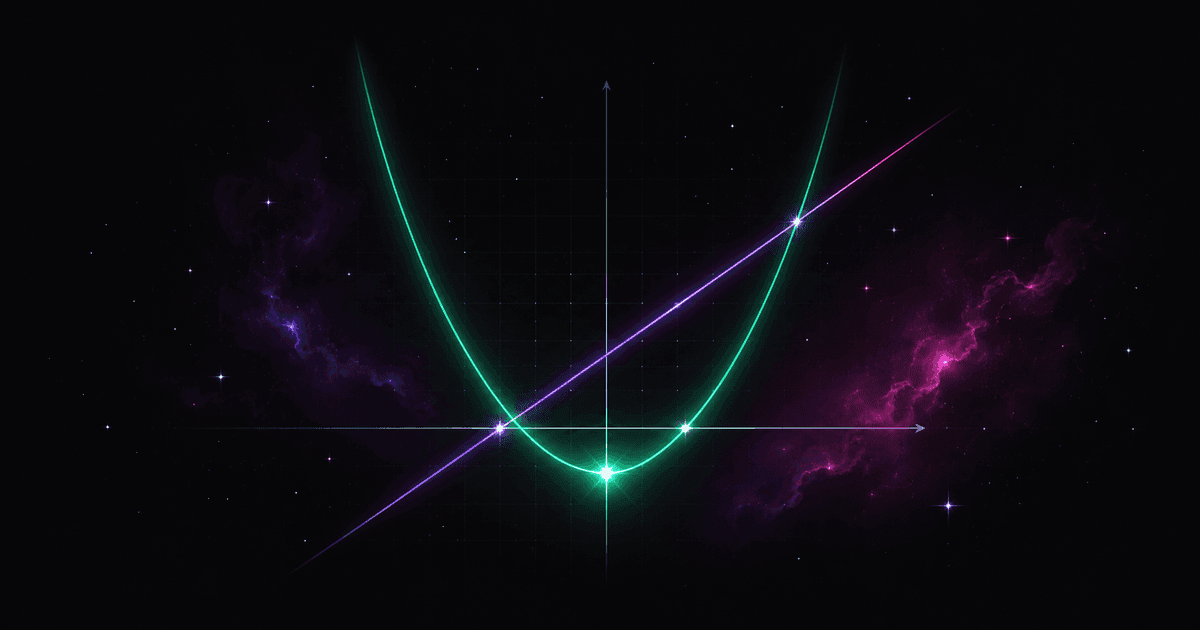
Quadratic function
A quadratic function f(x) = ax² + bx + c draws a parabola. Meet the vertex and the axis of symmetry, the three forms of the formula — general, canonical and factored — and how the sign of a decides between a minimum and a maximum.
Before you start
This topic builds on earlier ideas. Before you start, it's worth working through the lessons below — they'll make everything click:
- Linear functionA linear function y = ax + b draws a straight line. Meet the meaning of the slope and the intercept, the zero, the formula of a line through two points, the general form, and the conditions for parallel and perpendicular lines.
- Quadratic equationsA quadratic equation has the unknown in the second power. Learn the general form, the discriminant, the formulas for the roots, the shortcuts for incomplete equations, Vieta formulas and how to read the solutions off a parabola.
Where this is used
Real situations where you count exactly the way this lesson teaches:
- Braking distanceBraking distance grows with the square of the speed: s = v²/(2a). On dry asphalt the deceleration is around 7 m/s², so at 50 km/h (13.9 m/s) a car needs 13.8 m, and at 100 km/h it needs 55.1 m — four times as far for twice the speed. The same parabola is why dropping a limit from 50 to 30 km/h shortens braking to 5.0 m rather than to the 8.3 m a proportion would predict.
- Setting up a satellite dishA dish is a parabola of revolution, and that alone is why every parallel wave meets at a single point — the focus. For a dish 90 cm across and 8 cm deep, y = x²/(4f) gives 8 = 45²/(4f), so f = 63.3 cm. The LNB has to sit exactly that far from the base: 3 cm out of place smears the focus and the signal starts dropping in the first rain, while the dish still looks perfectly aimed.
- Driving under an archAn arched entry to a yard is 4 m wide and 3 m high at its peak, so its outline is the parabola y = 3 − 0.75x². A van 2.4 m wide runs its edge at x = 1.2 m, where the clearance is 3 − 0.75 · 1.44 = 1.92 m. A 1.90 m box clears it by 2 cm — measuring the height in the middle of the arch would promise a false 3 m and take the roof off.
All formulas
General form
the graph is a parabola
Coordinates of the vertex
(p, q) — the turning point of the parabola
Canonical form
the vertex is readable straight off it
Factored form
exists only when Δ ≥ 0; shows the zeros
Axis of symmetry
the vertical line through the vertex
Range
for a < 0 it is (−∞, q⟩
A quadratic function is a function given by
Its graph is a parabola. The condition is not a formality: were zero, the formula would collapse to , a linear function, and the graph would straighten into a line.
Arms, vertex, axis of symmetry
A parabola has one turning point — the vertex — and is symmetric about the vertical line through it:
The coordinates of the vertex come from the formulas:
where — the same delta we computed for quadratic equations. The safest way to get the second coordinate is as : the delta formula gives the same number but invites a sign slip.
The sign of decides which way the arms point:
Extremum and range
The vertex is the lowest or the highest point of the graph, so its second coordinate is the extreme value of the function:
- — arms up, a minimum of value at the vertex, range ;
- — arms down, a maximum of value at the vertex, range .
So a quadratic function never takes all real values — half of the vertical axis always stays empty. The domain, in contrast, is every real number: anything can be squared.
The axis of symmetry is also the boundary of monotonicity. For the function decreases to the left of and increases to the right; for it is the other way round.
The three forms
The same function can be written in three ways, and each shows something different without any computation:
- the general one shows the value at zero: ;
- the canonical one shows the vertex: ;
- the factored one shows the zeros: and .
The factored form exists only when there are zeros at all, that is when (at it takes the shape ). The canonical form exists always.
Note that the vertex sits exactly halfway between the zeros: . That is the fastest route to once the roots are known — and it comes straight from the symmetry of the parabola.
The zeros
The zeros of a quadratic function are the solutions of , that is the points where the parabola crosses the -axis. How many there are depends on the delta:
The whole computation — the formulas for and , the incomplete cases, Vieta's formulas — lives in the lesson on quadratic equations. What matters here is the consequence for the graph: when the parabola lies entirely above the axis (for ) or entirely below it (for ), so the function has a constant sign.
Where you see it
A parabola is not a school ornament but a shape nature and engineering pick on their own:
- projectile motion — a stone thrown at an angle travels along a parabola (air resistance aside);
- satellite dishes and reflectors — a parabolic dish gathers parallel rays into a single point, the focus;
- optimisation — questions like "the largest area for a given perimeter" lead straight to the vertex.
Exercises
The session covers the four skills of this lesson: the value at a point, the coordinates of the vertex, and rewriting the general form into the canonical and the factored one. For the vertex type two numbers separated by a comma — first , then . For a change of form type the finished formula, e.g. (x-2)^2-1.
Practice
Work through a set of exercises — they get harder as you go. At the end you'll see your score and the mistakes worth reviewing.
Common mistakes
- Losing the minus in — the formula is , so gives .
- Confusing with — lives on the horizontal axis, is a value of the function.
- The sign of and the arms — the arms point up when , not "always up".
- A factored form at — there is none, because there are no zeros.
- Taking for a zero — is the value at zero, the crossing with the -axis.
- Calling the range all real numbers — a parabola always stops at .
Formula card
Topic: Quadratic function
General form
the graph is a parabola
Coordinates of the vertex
(p, q) — the turning point of the parabola
Canonical form
the vertex is readable straight off it
Factored form
exists only when Δ ≥ 0; shows the zeros
Axis of symmetry
the vertical line through the vertex
Range
for a < 0 it is (−∞, q⟩