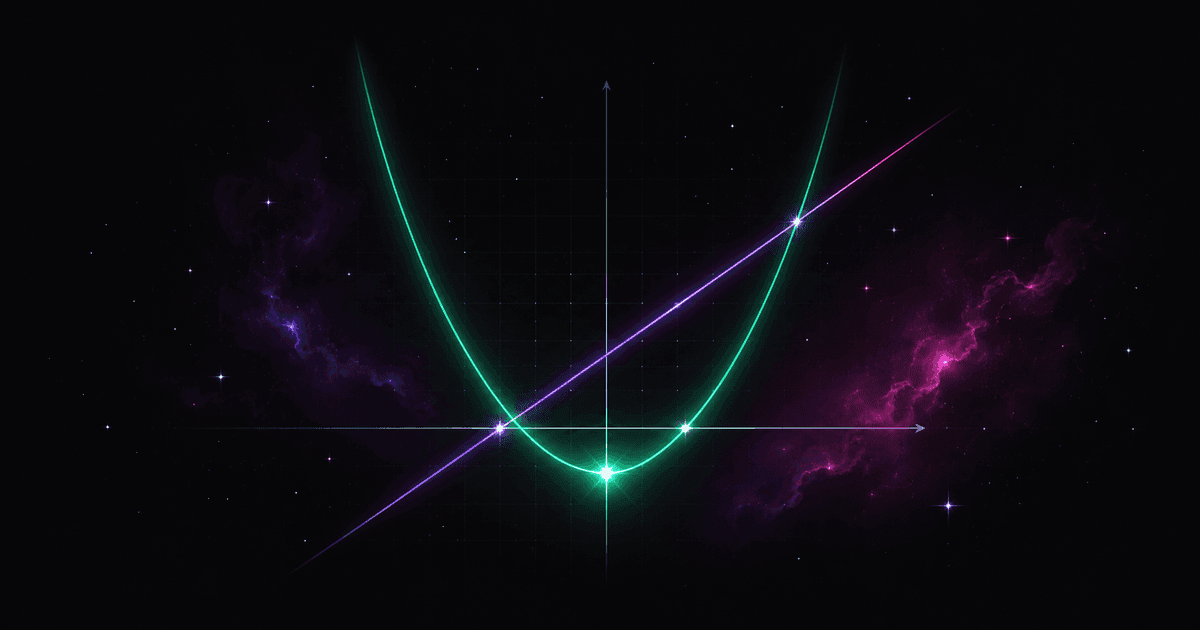
The integral
Integration is differentiation run backwards: we look for the function whose derivative is the one we started with. An indefinite integral gives a formula up to a constant, a definite one gives a number — and that number is the area under the curve.
Before you start
This topic builds on earlier ideas. Before you start, it's worth working through the lessons below — they'll make everything click:
- The derivativeA derivative measures how fast a function changes at a point — it is the slope of the tangent to the graph. Meet the definition through the difference quotient and the six rules that compute it without taking a limit every time.
- LogarithmsA logarithm answers the question of which power a base has to be raised to in order to give a number. Learn the definition of log_a b, the conditions on the base and the argument, the common and natural logarithms, and the four properties that turn multiplication into addition.
- Exponential and logarithmic functionsGrain on a chessboard, a loan, radioactive decay and the decibel scale — one pair of functions describes them all. See what the graph of y = bˣ looks like and why y = log_b x is its mirror image, how solving an exponential equation comes down to comparing exponents, and where the domain of a logarithm comes from.
Where this is used
Real situations where you count exactly the way this lesson teaches:
- Fuel used on a climbThe trip computer shows instantaneous consumption in litres per hour, while what you want to know is how much fuel actually went. On a two-hour climb consumption rises from 6 to 12 l/h, that is f(t) = 6 + 3t. The amount used is the integral: ∫ (6 + 3t) dt from 0 to 2 = [6t + 1.5t²] = 12 + 6 = 18 litres. Multiplying by the opening reading would say 12 l, by the closing one 24 l — both wrong, and the car’s own gauge does exactly what the integral does: it sums hundreds of short stretches.
- Work done compressing a springA spring rated 20 N/cm, pressed 8 cm, pushes back with a force rising from zero to 160 N. You cannot get the work as force times distance, because the force keeps changing — you have to integrate: W = ∫ 2000x dx from 0 to 0.08 = 1000 · 0.0064 = 6.4 J. The "peak force times distance" shortcut gives 12.8 J, exactly twice too much, and the designer would order an actuator of double the power it needs.
- The dose a worker absorbsA dosimeter measures dose rate in microsieverts per hour, while the regulations cap the total dose. When a cooling source has its dose rate falling as D(t) = 40 − 8t µSv/h, five hours of work give ∫ (40 − 8t) dt from 0 to 5 = 200 − 100 = 100 µSv, which is 0.5% of the 20 mSv annual limit. Without the integral the only safe answer would be to count at the highest rate — 200 µSv, and a shift half as long.
- Output from solar panelsA 5 kW peak array does not deliver 5 kW all day — the power is a curve and the output is the area under it. For the model P(t) = 5 − 0.2(t − 12)² kW between 07:00 and 17:00 the day yields ∫ P(t) dt = 33.3 kWh, not the 50 kWh that peak power times 10 hours suggests. That gap moves the payback from 8 years to 12, and it is the only number in the quotation that really means anything.
- Consumer surplusDemand for tickets follows the curve P(q) = 60 − 2q, where q counts thousands of viewers, and the market price is 20. Everyone who would have paid more keeps the difference, and the sum of those differences is the region between the demand curve and the horizontal price line: ∫ from 0 to 20 of (60 − 2q − 20) dq = [40q − q²] = 800 − 400 = 400, that is 400 thousand. No multiplication of price by ticket count produces that figure — it is the area between TWO curves rather than under one, and it is exactly what the audience gained over what it paid.
All formulas
Antiderivative
F is an antiderivative of f when differentiating F gives f
Indefinite integral
the result is a whole FAMILY of functions, hence the constant C
Power rule
the exponent grows by one, then divide by the new exponent
Newton–Leibniz formula
the constant C cancels in the subtraction, so it never matters
Area under a curve
the definite integral equals the area only above the axis
Area in general
where the curve dips below the axis, the area is computed piece by piece
Trigonometric functions
the minus sign changes sides compared with differentiation
The integral of 1/x
the one exponent the power rule cannot handle
The exponential function
its own derivative, so its own antiderivative too
Area between two curves
integrate the difference: upper curve minus lower
Differentiation answers the question "how fast is this changing". Integration asks the reverse: given the rate of change, what was the quantity? It is the operation inverse to the derivative — and at the same time the way to measure regions bounded by a curve.
The antiderivative
An antiderivative of a function is a function whose derivative is :
For an antiderivative is , because differentiating gives . But so is , and so is — the derivative of a constant is zero, so shifting a graph vertically leaves the slope at every point untouched.
There are therefore infinitely many antiderivatives, and they differ by a constant alone.
The indefinite integral
We write it like this:
The sign is an elongated "S" for sum, and says which variable we are integrating over. The constant of integration is not decoration: without it the notation would name one function instead of a whole family.
The power rule is the exact reverse of the one from differentiation — the exponent grows by one and then we divide by the new exponent:
| function | integral |
|---|---|
| (a constant) | |
The restriction is there because would mean dividing by zero. That one exponent — together with the exponential function, which is not a power of the variable at all — is what the next section takes on.
A sum is integrated term by term, and a constant factor passes through an integral just as it passes through a derivative.
Two rows the power rule cannot reach
The last two rows of the table come the same way as every row before them: by reversing a derivative you already know. There is no new technique here — only a familiar equality read from right to left.
The integral of . The derivative of the natural logarithm is , so:
The absolute value is not decoration. A logarithm is defined for positive arguments only, whereas makes sense for negative ones too — and there the antiderivative is , because . Writing covers both halves of the domain with one formula. The logarithm as an operation is taught in logarithms, and its graph in exponential and logarithmic functions.
That closes the power rule: for every exponent the integral is , and for it is a logarithm. There is no gap left.
The integral of . The exponential function with base is its own derivative, so it is its own antiderivative as well:
Up to a constant factor it is the only function with that property, and that is where the standing of the number throughout analysis comes from: with any other base both the derivative and the integral drag an extra factor along.
The definite integral and Newton–Leibniz
Once limits of integration are written on the integral sign, the result stops being a function and becomes a number:
This is the Newton–Leibniz formula, one of the great theorems of mathematics: it ties differentiation to the measurement of areas. The computation has three steps — find an antiderivative, substitute the upper limit, subtract the value at the lower one.
The constant is irrelevant here, because it cancels in the subtraction:
The area under a curve
Where do areas come into it? Slice the region under a graph into narrow vertical strips. Each is almost a rectangle of area , and the narrower the strips, the smaller the error. Passing to the limit — exactly the limit we met with the derivative — turns the sum of rectangle areas into an integral.
For a function that is non-negative across the interval, the definite integral simply is the area:
Check it against the drawing above. The area of a triangle of base and height is , and the integral:
They agree — and that is the whole power of the method: for a straight line geometry already knew the answer, but the integral computes the region under any curve, including those no formula in a book of shapes covers.
When the curve dips below the axis
A definite integral measures area with a sign: stretches below the axis enter it with a minus. That is why "integral = area" only holds for non-negative functions.
Compute both numbers. The antiderivative is , so:
The area, on the other hand, is taken piece by piece with absolute values:
In general:
The recipe is simple: find the zeros inside the interval, integrate over each piece separately, and add the absolute values of the results.
The area between two curves
So far the other boundary of the region has always been the axis, the line . Nothing forces that choice: a region can just as well be closed between two curves.
The computation is the one we already have, only the strip is shorter. The narrow vertical strip above a point runs from the lower curve to the upper one, so its height is , and the area is the sum of the strips:
Note that nothing is assumed about signs: both curves may lie below the axis and the difference is non-negative all the same. What matters is the ordering — the lower curve is taken away from the upper.
Very often the problem states no interval at all, because the region is closed by the curves themselves. Then the limits of integration are computed: they are the intersections, the solutions of .
Let us compute that area. The intersections:
so and . On that interval the parabola is the upper curve, so we integrate :
When the curves swap places
The formula assumes that the same curve stays on top across the whole interval. If the curves meet inside it, that assumption fails and the move is exactly the one used for a curve crossing the axis: split the interval at the intersection and add the areas of the pieces.
Two questions, two answers
It pays to keep three easily confused things apart:
- the indefinite integral — a function (a family of functions), the answer to "what is this the derivative of";
- the definite integral — a number, the result of the subtraction , possibly negative;
- the area — a non-negative number, equal to the integral only when the curve stays above the axis.
That last distinction is the commonest source of wrong answers in area problems.
Exercises
The three kinds of question match the three parts of this lesson. For the indefinite integral, type an antiderivative — the constant C may be written out or left off, because the answer is graded up to a constant. For the definite integral the answer is a number, and it may well come out negative. For the area under a graph the answer is always non-negative, and in the harder questions the curve crosses the axis inside the interval — then the area is computed piece by piece.
Practice
Work through a set of exercises — they get harder as you go. At the end you'll see your score and the mistakes worth reviewing.
Common mistakes
- Dropping the constant C — the result of an indefinite integral is a family of functions, so belongs to the answer.
- Integrating as if differentiating — in an integral the exponent grows, and then you divide by the new exponent.
- Equating the integral with the area — below the axis the integral is negative and an area never is.
- Adding the pieces without the modulus — that gives the integral back, not the area.
- Subtracting in the wrong order — it is : the lower limit is taken away from the upper one.
- Carrying C through a definite integral — it cancels anyway and only clutters the computation.
- Subtracting the wrong way round between two curves — integrate upper minus lower; the other order returns the area with a minus sign.
- Dropping the modulus in — is an antiderivative only for ; negative arguments need .
Formula card
Topic: The integral
Antiderivative
F is an antiderivative of f when differentiating F gives f
Indefinite integral
the result is a whole FAMILY of functions, hence the constant C
Power rule
the exponent grows by one, then divide by the new exponent
Newton–Leibniz formula
the constant C cancels in the subtraction, so it never matters
Area under a curve
the definite integral equals the area only above the axis
Area in general
where the curve dips below the axis, the area is computed piece by piece
Trigonometric functions
the minus sign changes sides compared with differentiation
The integral of 1/x
the one exponent the power rule cannot handle
The exponential function
its own derivative, so its own antiderivative too
Area between two curves
integrate the difference: upper curve minus lower