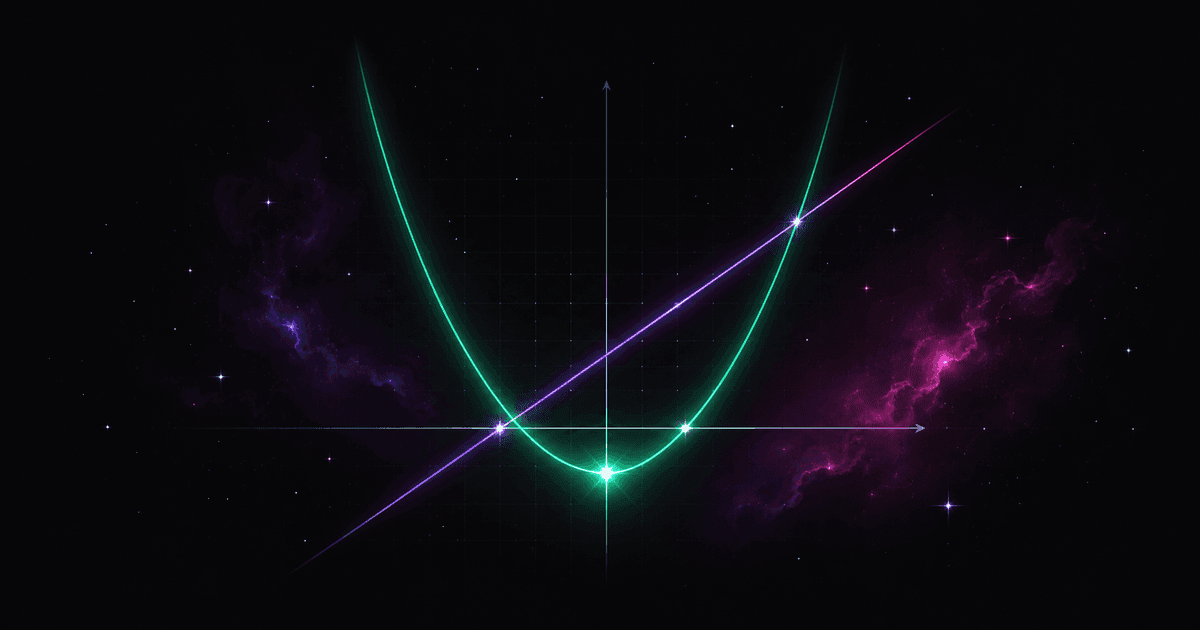
The derivative
A derivative measures how fast a function changes at a point — it is the slope of the tangent to the graph. Meet the definition through the difference quotient and the six rules that compute it without taking a limit every time.
Before you start
This topic builds on earlier ideas. Before you start, it's worth working through the lessons below — they'll make everything click:
- Limit of a functionA limit says where the values of a function are heading as the argument closes in on a number — even when the function has no value at that number at all. It is the first idea of analysis and the ground the derivative stands on.
- PowersA power is shorthand for multiplying the same factor by itself. Learn the base and the exponent, the laws of exponents, powers of a product and of a quotient, zero and negative exponents, the monotonicity of exponentiation, and scientific notation.
- Composition and inverse functionsTwo functions set one behind the other, and one function run backwards. See why f(g(x)) is not g(f(x)), how the monotonicity of a composition follows from its parts, when a function can be inverted at all, and why the graph of the inverse is a reflection in the line y = x.
Where this is used
Real situations where you count exactly the way this lesson teaches:
- Pace on a running watchThe watch has no speed sensor — all it knows is a run of GPS positions. It gets instantaneous speed from a difference quotient: over one second the position moved 3.1 m, which is 3.1 m/s, or 11.2 km/h, a pace of 5:23 min/km. The shorter the interval, the closer the figure gets to the value right now, and that limit as h goes to zero is precisely the definition of the derivative — displayed on your wrist once a second.
- Marginal cost in productionMaking x units costs K(x) = 0.02x² + 18x + 4000. The derivative K′(x) = 0.04x + 18 says what one more unit costs: 38 at an output of 500, already 78 at 1,500. That is not the average cost, which at 500 units is 18,000/500 = 36 — and it is the derivative, not the average, that settles whether to take an extra order at 45 a unit.
- How sensitive a mortgage payment isA 300,000 mortgage over 25 years costs 1,933 a month at 6% and 2,120 at 7%. The derivative of the payment with respect to the rate is about 187 per percentage point around 6%. That single number says what every move in rates will cost before it happens, and it is a far better affordability test than the size of today’s payment.
All formulas
Definition of the derivative
the limit of the difference quotient as the increment shrinks to zero
Power rule
the exponent steps in front of x and drops by one
Constants and sums
a constant factor passes through; a sum differentiates term by term
Product rule
the derivative of a product is NOT the product of the derivatives
Quotient rule
a difference on top — the order matters
Chain rule
the outer derivative times the derivative of the inside
Root and reciprocal
the same power rule with exponents ½ and −1
Trigonometric functions
the cosine picks up a minus sign
The graph of a function is rarely a straight line, so the question "how fast does it grow" has no single answer — at every point it grows differently. The derivative is the tool that gives that rate for one point.
The difference quotient: an average rate of change
Start with something we can already compute: the slope of a secant, the line through two points of the graph.
For , the point and an increment :
This fraction is the difference quotient. It only speaks about the whole stretch, though — and what we want is the rate exactly at .
From secant to tangent
So let shrink. The point slides down the curve towards and the secant rotates about :
| point | difference quotient | |
|---|---|---|
The numbers head for — and that is no coincidence, because the difference quotient simplifies:
As only remains. The secant stops being a secant: it touches the graph at a single point and becomes the tangent.
The definition
The derivative of at is the limit of the difference quotient as the increment tends to zero. Note that at the fraction reads — without the limit from the previous lesson this definition would make no sense at all.
Three readings of the same number:
- geometric — the slope of the tangent to the graph at ;
- physical — the instantaneous speed, when the argument is time and the value is distance;
- practical — roughly how much the value moves when the argument grows by one unit.
Asking for the derivative at every point at once produces a new function, written — and that function is usually what the computation is after.
The power rule
Computing every derivative from the definition would be punishing. Fortunately the definition yields rules that are then applied mechanically. The most important one:
The exponent steps in front of and drops by one. The rule holds for any exponent — fractional and negative included, which settles roots and reciprocals:
| function | as a power | derivative |
|---|---|---|
| (a constant) | ||
| — | ||
| — |
The derivative of a constant is zero, because a constant function does not change — its graph is horizontal, and the slope of a horizontal line is .
Constants, sums and polynomials
Two rules that break any polynomial into pieces:
A constant factor passes through the derivative untouched, and a sum is differentiated term by term. Together with the power rule that is a recipe for any polynomial:
Every term on its own, and the constant term disappears.
The product rule
The derivative of a product is not the product of the derivatives — worth checking on the simplest example there is. With we get , while the product of the derivatives is .
The quotient rule
There is a difference on top, so the order matters — swapping the two terms flips the sign of the whole answer. The denominator is squared.
The chain rule
When a function is a composition — something substituted into something else — differentiate the outer function as if its inside were a plain , then multiply by the derivative of the inside. That multiplication is the easiest thing in calculus to forget.
Exercises
The exercises walk through every rule in this lesson in turn: a power with a non-integer exponent, a polynomial, a product, a quotient, a composition, and the value of a derivative at a point. Where the question asks for the answer is a function — type it in any correct form, because what is graded is equality of functions rather than of strings (6x^2 + 2x - 6 and 6x²+2x−6 pass alike). Only the last kind of question, about , expects a number.
Practice
Work through a set of exercises — they get harder as you go. At the end you'll see your score and the mistakes worth reviewing.
Common mistakes
- Dropping the derivative of the inside — , not .
- Multiplying derivatives instead of using the product rule — , never .
- Reversing the quotient rule — the numerator is first, then subtracted.
- A constant differentiating to a constant — a constant function does not change, so its derivative is .
- Losing the minus in 1/x and in the cosine — and .
- Confusing f′(x) with f′(x₀) — the first is a function, the second a number: that function's value at one point.
Formula card
Topic: The derivative
Definition of the derivative
the limit of the difference quotient as the increment shrinks to zero
Power rule
the exponent steps in front of x and drops by one
Constants and sums
a constant factor passes through; a sum differentiates term by term
Product rule
the derivative of a product is NOT the product of the derivatives
Quotient rule
a difference on top — the order matters
Chain rule
the outer derivative times the derivative of the inside
Root and reciprocal
the same power rule with exponents ½ and −1
Trigonometric functions
the cosine picks up a minus sign